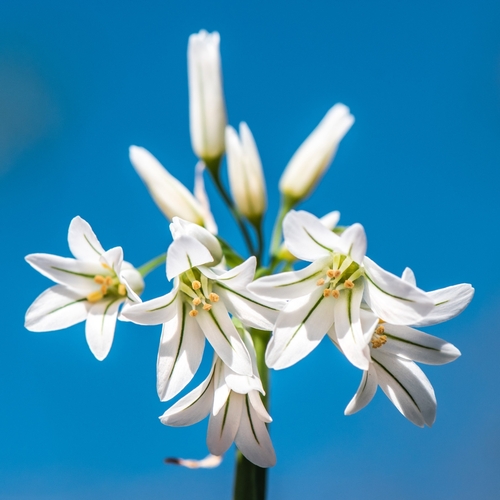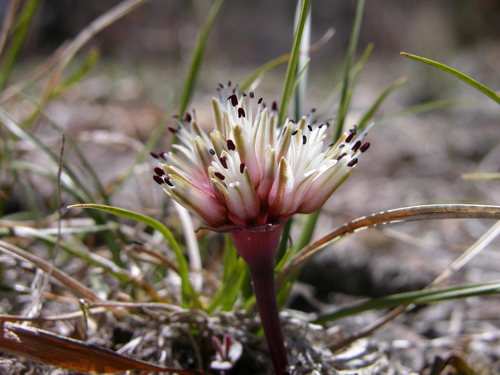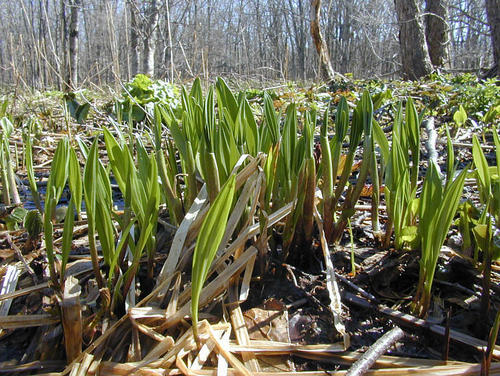
About Allium ochotense Prokh.
Allium ochotense Prokh. grows 20–30 cm (8–12 in) tall, has a strong garlic-like odor considered more intense than that of true garlic, linked to allicin content. Its bulbs are surrounded by a grayish-brown, netlike coating. It produces 1–3 glabrous, broadly elliptic leaves, and its whitish-green perianth forms the plant's flowers. This is a slow-growing species. It can reproduce by seed, and like related Allium victorialis, it has two vegetative propagation systems: tillering and formation of adventitious buds. This species is primarily distributed around the Amur River basin. In the Russian Far East, it occurs in the Amur, Khabarovsk, and Primorye regions of Siberia, as well as on Sakhalin and the Kuril Islands. In China, it grows in Inner Mongolia, Heilongjiang, Jilin, Liaoning, Hebei, Henan, Anhui, Hubei, Zhejiang, Shaanxi, Shanxi, Gansu, and Sichuan. Its range also includes Korea, where it grows on Ulleungdo and on high mountains over 1,000 metres (3,300 ft) across the Korean Peninsula, including Paektu Mountain. In Japan, it is found on Hokkaido and Honshu, growing in colonies from Hokkaido down to the Kinki area (Nara Prefecture), in coniferous and mixed forested wetlands of subalpine terrain. Its range nominally extends into the United States, where it only grows natively on Attu Island, the westernmost island of the Aleutian archipelago; colonies found on Unalaska Island are thought to be introduced. Starting around 1990, Allium ochotense has been grown horticulturally in Hokkaido and snowy regions on the eastern side of Honshu, Japan. Plant disease outbreaks have been reported in these cultivation farms. It requires approximately four years from sowing to harvest.