About Allium moly L.
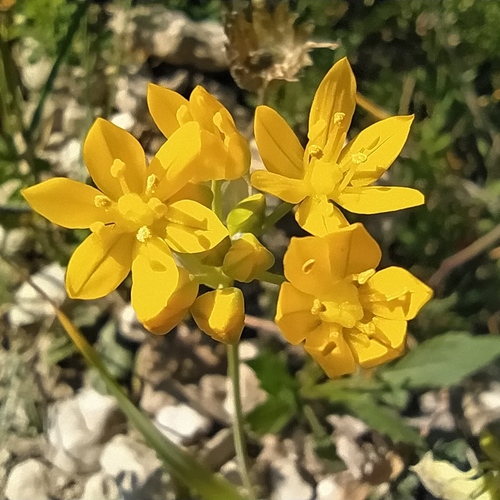
Allium moly L. is a plant species that produces lance-shaped grey-green leaves up to 30 cm long. When its leaves are crushed, they release an onion-like fragrance. Foliage dies back in mid-summer, and in early summer the plant produces masses of star-shaped bright yellow flowers held in dense umbels. On average, this species has a mean scape length of 24.5 cm and a mean inflorescence diameter of 5.8 cm. Its total annual flowering period lasts around 22 to 25 weeks. The cultivar 'Jeannine' has earned the Royal Horticultural Society's Award of Garden Merit. Allium moly is primarily native to Spain and Southern France, with additional wild populations located in Italy, Austria, the Czech Republic, Algeria, and Morocco. For cultivation, Allium moly is recommended to be planted in well-drained soil; while it can grow in any soil type, sandy loams are ideal. It requires partial shade, and needs protection from afternoon sun during hot summers. Bulbs should be planted roughly 5 inches deep, spaced 2 to 3 inches apart. Bulb size directly impacts the plant's blooming timeline, bloom length, and flower count. Bulbs with a 6 to 7 cm circumference bloom the earliest, around June 8, produce the highest proportion of flowering bulbs (around 92.4% of bulbs bloom), and have the longest blooming period of 2.5 to 3 weeks. Contrastingly, bulbs with a 3 to 4 cm circumference bloom the latest, around June 12, and have a shorter flowering period of around 1.5 weeks. Smaller circumference (3 to 4 cm) bulbs produce more inflorescence stems, larger inflorescence diameters, and more flowers per inflorescence than smaller bulbs. Plants sprayed with a 0.2% solution of Asahi SL have blooming periods that are 8 to 20 days longer on average than plants sprayed with water. This species, commonly called yellow garlic, has both medicinal and culinary uses. It contains allicin, a component found in other types of garlic, and has documented antifungal and antibacterial medicinal properties. Both the bulb and leaves can be eaten raw or cooked, while flowers can only be consumed raw. Sliced Allium moly bulb has a mild garlic flavor; sliced bulbs can be cooked into dishes as flavoring or added raw to salads, and leaves can be used in the same ways as bulbs. When consumed, Allium moly offers health benefits from its antioxidants and bioactive compounds, and these benefits vary based on preparation method. Crushing the plant has a positive effect on its bioactive components. Some preparation methods can lead to loss of bioactive compounds. Heat increases bioaccessibility of the plant's bioactive components and triggers the release of phenolic compounds. Soaking Allium moly in water causes bioactive compounds to leach into the water; this can be limited by using very little water and cooking the plant in its own moisture, and any soaking or cooking water should be retained rather than discarded due to the transferred compounds. Baking, grilling, and frying are the best preparation methods to preserve phenolic compounds and maintain bioavailability of active components.