About Allium cernuum Roth
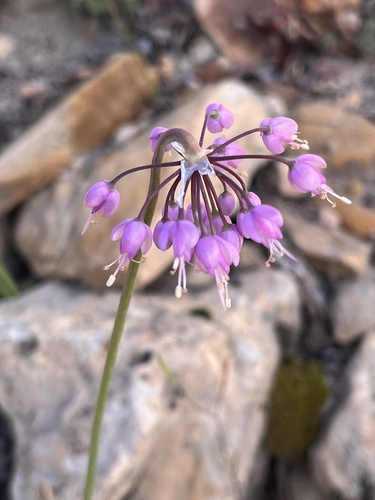
Allium cernuum Roth is a herbaceous perennial plant that grows from an unsheathed, elongated conical bulb. This bulb tapers gradually and directly into several keeled, thin and flat, grass-like leaves that are 2–4 millimetres (3⁄32–5⁄32 inch) wide. Each mature bulb produces a single flowering stem, which ends in a downward-nodding umbel of white or rose, bell-shaped (campanulate) flowers that bloom between July and August. Each flower measures around 5 mm (3⁄16 in) across, can be pink or white, and has yellow pollen and yellow anthers. Unlike some related species, Allium cernuum does not produce bulblets within its inflorescence. After flowering, the blooms develop into spherical, crested fruits that later split open to reveal dark, shiny seeds. This species has been recorded across large areas of the United States, Canada, and Mexico. Confirmed locations include the Appalachian Mountains from Alabama to New York State, the Great Lakes Region, the Ohio and Tennessee River Valleys, the Ozarks of Arkansas and Missouri, and the Rocky and Cascade Mountains of the western U.S., ranging from Mexico north to Washington. It has not been recorded from California, Nevada, Florida, Louisiana, Mississippi, New Jersey, Delaware, New England, or most of the Great Plains. In Canada, it grows from Ontario to British Columbia. Despite its broad overall distribution, it is absent from large portions of its potential range. In the southern part of its North American range, it is restricted to mountainous habitats. Across other parts of its North American range, it only occurs in small, disconnected local populations. It is not found in North Dakota, most Great Plains states, or the U.S. intermountain region, and it is listed as a threatened species in Minnesota. Its natural growing habitats range from deciduous woodlands to open grasslands. Allium cernuum is edible and has a strong onion flavor, but it is not considered to have culinary value in modern times. It is cultivated in gardens for its distinctive nodding flowers, which can be white, pink, or maroon. It is winter hardy in U.S. Department of Agriculture hardiness zones 3–9. Over time, plants grown in gardens often form dense clusters of bulbs from offsets produced by the parent bulb. Plants grow best in full sun with well-drained soil, though they benefit from some shade, especially in the afternoon, in hot climates.