About Allium bisceptrum S.Watson
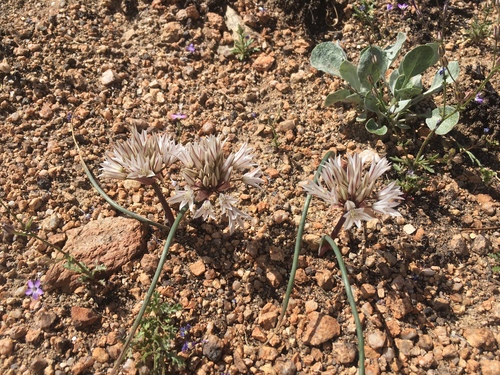
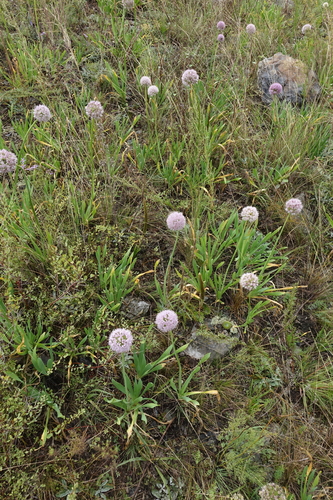
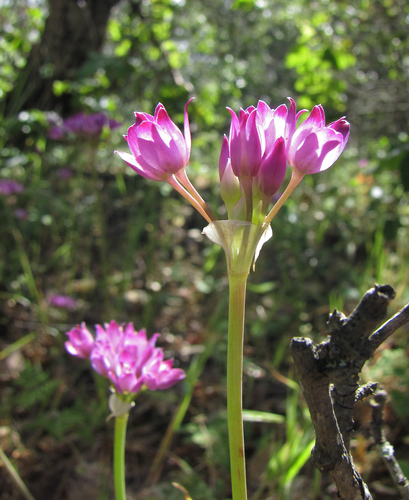
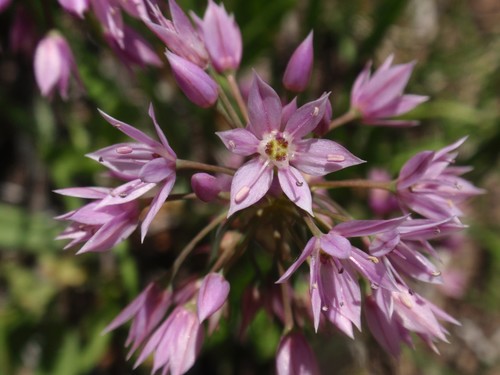
Allium bisceptrum S.Watson, commonly called twincrest onion, is a perennial plant that grows at altitudes between 2000 and 2900 meters, reaching a height of 10 to 40 cm. It produces round to egg-shaped onion bulbs with a light color that give off a strong odor when cut. Its flower clusters measure about 10–15 mm across, and hold flowers that range in shade from purple to pink. Each flower has six sharply pointed tepals, which often have a darker central stripe. Its long, flat leaves usually grow in pairs, remain green longer than the leaves of most other onion species, and release an odor when scratched. This species is found in mixed pine forests or wetland-riparian habitats in California, where it grows particularly well near streambanks, in aspen groves, and in meadows. In California, it is distributed across Alpine, El Dorado, Glenn, Inyo, Lassen, Mendocino, Mono, Modoc, Mariposa, Nevada, Plumas, San Bernardino, San Diego, Shasta, Sierra, Trinity, Tulare, and Tuolumne counties. It is also widely distributed in Nevada, Utah, Arizona, southeastern Oregon, and southern Idaho, with isolated populations recorded in northern Idaho and Franklin County, southeastern Washington. Twincrest onions are adapted to high elevations and grow well in cold conditions. Their seeds can be planted outdoors in early fall, and do not require warm temperatures over winter; in fact, warmer winters may require cooling the plants to ensure successful growth and germination. Soil must be well-drained and not waterlogged. Seeds should be planted densely at a rate of four to five seeds per square foot of soil. Early watering is not needed unless conditions are extremely dry, as rainwater is typically sufficient to sustain the plant until spring germination. Once spring arrives, the plants should receive two inches of water per week. They can grow in full sun, but prefer shade. Soil must be kept consistently moist but not overly wet, as young growing onion bulbs do not have enough energy reserves to survive if conditions are too wet. Watering should stop once foliage begins to turn yellow, at which point the plant is ready to mature and flower on its own. Plants grown from seed take at least three to five years to reach flowering size. Twincrest onion can also be grown from mature bulbs or bulblets, which reach maturity and flowering faster than seed-grown plants. To grow from bulbs, bulbs must be harvested from a mature wild plant and stored in a dry environment; dry peat moss inside a paper bag is an ideal storage option. The best time to plant these stored bulbs is late fall, after the first frost. They should be planted in acidic potting soil mixed with sand and humus to ensure good drainage. Daughter bulblets may be planted next to mature bulbs to maintain a dense growing pattern. Bulbs must be monitored to ensure they do not receive too much water. They will germinate on their own in spring. Once spring germination begins, bulbs should be watered at least once a week, and twice a week during dry, rainless weeks. Adding a liquid fertilizer can improve growth and plant vigor. Watering can stop once the plant begins to flower. When harvesting this plant, the Washoe people leave some individual plants intact so the species can continue to reseed, and do not uproot all bulbs to allow regrowth year after year. Today, twincrest onion is still used by many Native American groups including the Nevada Northern Paiute, Gosiute, Northern Ute, and Washoe. The Washoe use the plant's leaves and greens as a spice to flavor food. They harvest young leaves and stems from plants only a few inches above ground in early spring, after the last snow melts. These young growths are the most palatable, with a flavor that ranges from mild to strong, similar to commercially sold chives. They can be used in many culinary preparations, eaten raw or stir-fried with meat and other vegetables. Sometimes the Washoe pray before harvesting these leaves to wish for a good harvest year. Wild animals native to the plant's range, including elk, black bears, white-tailed prairie dogs, and mantled ground squirrels, eat the bulbs of this wild onion. Some cattle and sheep also graze on these plants.