About Allium anceps Kellogg
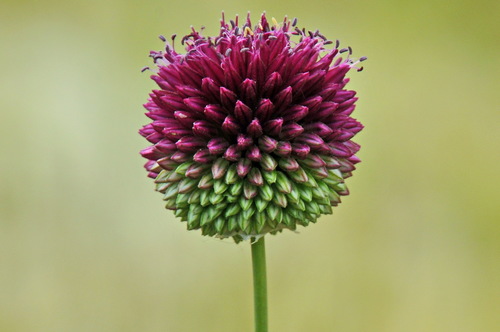
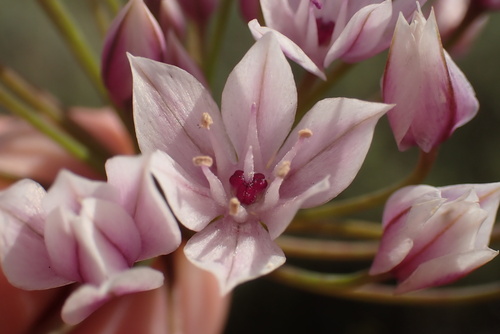
Allium anceps, commonly called twinleaf onion or Kellogg's onion, is a species of wild onion native to the western United States. It is widespread across Nevada, and extends into adjacent areas of California, Idaho, and Oregon. It grows in barren clay and rocky soils. This is a perennial herb that grows from a bulb, and produces a flowering scape from each bulb. Individual bulbs measure up to 2 cm (3⁄4 in) in both length and width, and plants can grow up to five bulbs, sometimes wrapped together by a brown or yellow-brown outer coat. The plant produces two flat, smooth-edged, sickle-shaped leaves that reach up to 26 cm (10 in) long. The flowering scape is erect, growing up to 15 cm (6 in) tall, and is flattened with winged edges. It bears an umbel inflorescence holding 15 to 35 flowers, with two spathes at the base of the umbel. The flowers are star-shaped, roughly 1 cm (1⁄3 in) wide, with six pink tepals that have green veins. The six stamens are tipped with yellow anthers that hold yellow pollen. After the plant's seeds mature, the scape dies and breaks off, usually taking the leaves with it. The bulbs are edible, and they were historically used as a food source by the Northern Paiute people, who roasted the bulbs and pressed them into cakes.