About Allium ampeloprasum L.
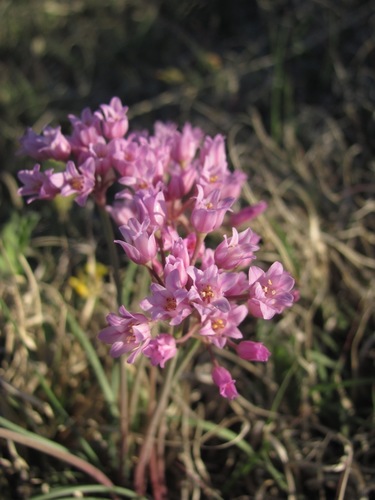
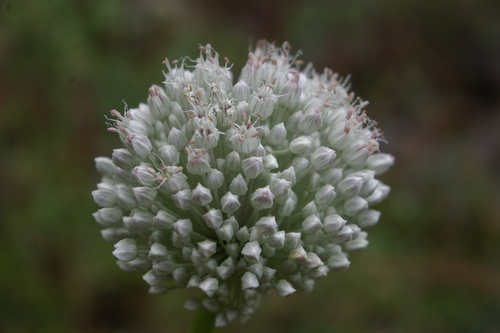
Allium ampeloprasum L. is a species of allium with the following characteristics. In wild populations, individuals produce bulbs up to 3 centimetres (1+1⁄4 inches) across. Scapes are round in cross-section, reaching up to 180 cm (71 in) tall, and each bears an umbel that can hold as many as 500 flowers. Flowers are urn-shaped, up to 6 millimetres (1⁄4 inch) across. Tepals may be white, pink, or red; anthers may be yellow or purple; pollen is yellow. The native range of this plant extends from southern Europe to southwestern Asia and North Africa, including all countries bordering the Black, Adriatic, and Mediterranean Seas from Portugal to Egypt to Romania. In Russia and Ukraine, the species is considered invasive, except in Crimea where it is native. It is also native to Ethiopia, Uzbekistan, Iran, and Iraq. It has become naturalized in the United Kingdom, Ireland, the Czech Republic, the Baltic States, Belarus, the Azores, Madeira, the Canary Islands, Armenia, Azerbaijan, Afghanistan, China, Australia (all states except Queensland and Tasmania), Mexico, the Dominican Republic, Puerto Rico, Haiti, the United States (the southeastern region plus California, New York State, Ohio, and Illinois), the Galápagos, and Argentina. It is possible the species was introduced to Britain by prehistoric people; in Britain, it grows in rocky places near the coast in south-west England and Wales. Allium ampeloprasum is the parent species of several cultivated vegetable varieties, most notably: Leek (var. porrum); Elephant garlic, also called great-headed garlic (var. ampeloprasum); Pearl onion (var. sectivum); Kurrat (var. kurrat), also known as Egyptian leek or salad leek, which has small bulbs and is primarily grown for its edible leaves; and Persian leek (A. ampeloprasum ssp. persicum), a cultivated allium native to the Middle East and Iran grown for culinary use, called tareh in Persian. Persian leek has linear green leaves with a mild onion flavor that are eaten raw, either on their own or combined into other dishes. Some sources, especially archaeological sources, classify each of these cultivated types as separate species, but they are currently all grouped together as Allium ampeloprasum L.