About Alliaria petiolata (M.Bieb.) Cavara & Grande
Taxonomy and Growth Habit
Alliaria petiolata, or garlic mustard, is an herbaceous biennial plant that grows from a deep, thin, whitish taproot that smells like horseradish. In their first year of growth, plants form low-growing rosettes of green leaves that stay green through winter, then develop into mature flowering plants the following spring.
Mature Plant Height
Second-year plants typically reach 30–100 cm (12–39 in) tall, and may rarely grow as tall as 130 cm (51 in).
Leaf Morphology
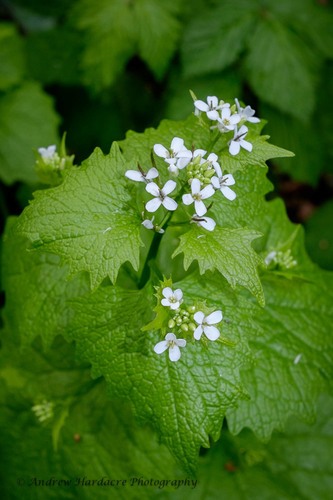
Its leaves are stalked, ranging from triangular to heart-shaped, 10–15 cm (3.9–5.9 in) long (around half of this length is the petiole) and 5–9 cm (2.0–3.5 in) broad, with coarsely toothed margins.
Flowering Period
Flowers grow in small clusters through spring and summer.
Flower Structure
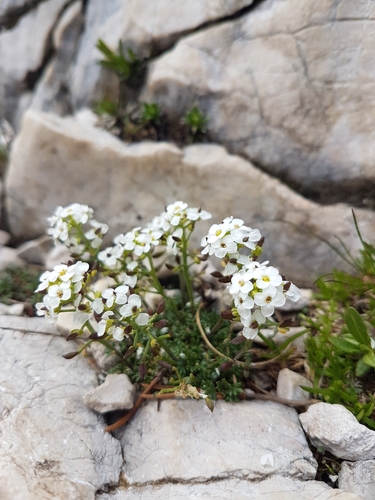
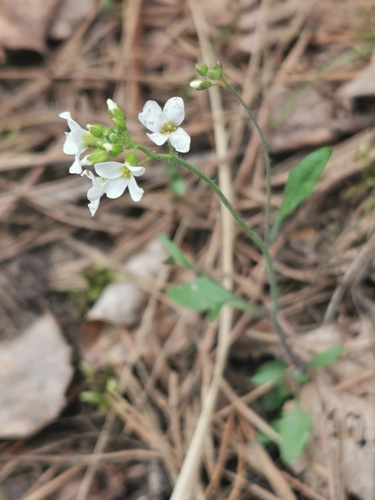
Each small flower has four white petals 4–8 mm (0.2–0.3 in) long and 2–3 mm (0.08–0.12 in) broad, arranged in a cross shape.
Fruit Structure
The fruit is an erect, slender, four-sided capsule 4–5.5 cm (1.6–2.2 in) long, called a silique. It is green when young, and matures to pale grey brown.
Seed Characteristics and Dispersal
It holds two rows of small, shiny black seeds that are released when the silique splits open. A single plant can produce hundreds of seeds, which often scatter several meters away from the parent plant.
Pollination Strategy
Depending on growing conditions, garlic mustard is either self-fertilizing or cross-pollinated by a variety of insects.
Associated European Organisms
In Europe, 69 species of insect herbivores and 7 fungi are associated with garlic mustard. The most important groups of natural enemies associated with this plant are weevils (particularly those in the genus Ceutorhynchus), leaf beetles, butterflies, and moths; this includes the larvae of some moth species such as the garden carpet moth.
Flower Aroma and Pollinators
The small white flowers have a rather unpleasant aroma that attracts midges and hoverflies, though the flowers usually pollinate themselves.
Orange Tip Butterfly Interaction
In June, pale green caterpillars of the orange tip butterfly (Anthocharis cardamines) can be found feeding on the long green seed-pods, where they are very hard to distinguish from the pods themselves.
Cyanide Content
Young first-year garlic mustard plants contain up to 100 ppm cyanide, a level that is toxic to many vertebrates. Once the plant is chopped up, the cyanide gas is eliminated.
Ancient Culinary Use in Europe
Garlic mustard is one of the oldest spices used in Europe. Phytoliths found in pottery from the Ertebølle and Funnelneck-Beaker cultures of north-eastern Germany and Denmark, dated to 4100–3750 BCE, show the plant was in use by this time.
17th-Century British Culinary Use
In 17th-century Britain, it was recommended as a flavouring for salt fish. It can also be made into a sauce to serve with roast lamb or salad.
Introduction to North America
Early European settlers brought the herb to the New World to use as a garlic-like flavouring.
Traditional Medicinal and Erosion Control Uses
Its traditional medicinal uses include acting as a diuretic. The herb was also planted to help control erosion.
Modern Culinary Uses
Today, chopped leaves are used to add flavour to salads and sauces such as pesto, and sometimes the flowers and fruit are added as well. The leaves, which are best when young, taste of both garlic and mustard.
Additional Culinary and Medicinal Uses
In France, the seeds are sometimes used to season food. Garlic mustard was once used medicinally as a disinfectant, and was sometimes used to treat wounds.