About Allamanda schottii Pohl
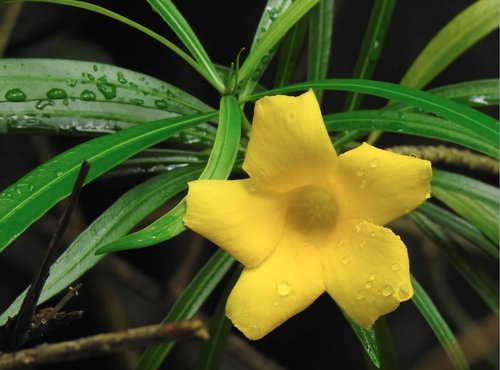
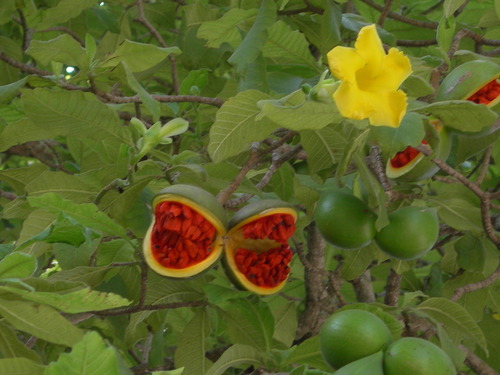
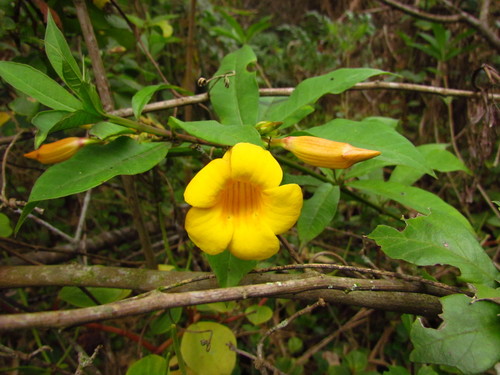
Unlike many other species in the genus Allamanda, Allamanda schottii is a shrub rather than a vine. It grows 1.5 to 3 meters (5–10 feet) tall and reaches roughly 2 meters (6–8 feet) wide. Its leaves, which are elliptic to obovate in shape, are arranged in whorls of 3 to 5 or subopposite along the stem. Leaves measure 2–14 cm long and 1.1–4 cm wide. The large yellow flowers grow terminally, meaning they appear at the ends of branches. Flowering can occur year-round, but blooms are most abundant in spring. Spiny fruits develop mostly during summer.
In its native range, Allamanda schottii occurs in southern and southeastern Brazil, specifically in the states of Espírito Santo, Minas Gerais, Rio de Janeiro, São Paulo, Paraná and Santa Catarina. It was previously thought to be endemic only to Brazil, but populations were reported in northeastern Argentina in 2013. Within Brazil, this plant grows near or alongside bodies of water, often in wet locations within open or closed forests. It has become naturalized in Puerto Rico, the Galapagos Islands and Costa Rica, and has been recorded escaping from cultivation in Australia.
The flowers of Allamanda schottii are pollinated by butterflies in the genus Phoebis; bees and wasps also visit the flowers. The stems and leaves contain a milky sap that acts as an irritant. The plant contains the compound plumericin, which causes gastrointestinal irritation.
In cultivation, Allamanda schottii is hardy in USDA zones 10–11 and is tolerant of dry periods. It grows best in rich, well-drained soil, and benefits from regular pruning, as it becomes spindly without this maintenance. The cultivar 'Silver dwarf discovery' has silvery leaves and grows less vigorously than the species.