About Allamanda cathartica L.
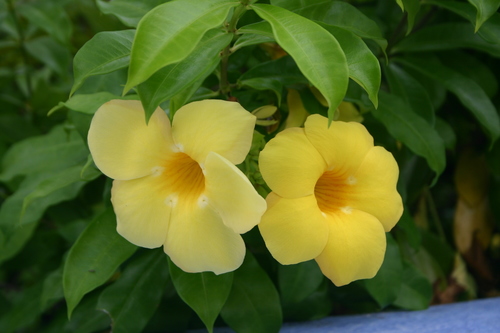
Allamanda cathartica L., commonly known as golden trumpet, common trumpetvine, and yellow allamanda, is a flowering plant species belonging to the family Apocynaceae. It is native to Bolivia, Brazil, French Guiana, Guyana, Suriname, and Venezuela, and is widely naturalized in other tropical regions around the world. This species is mentioned in Carl Friedrich Philipp von Martius' Flora Brasiliensis. Unlike many climbing vines, it does not twine, and does not produce tendrils or aerial roots. It can be pruned to maintain a shrub shape. If left unpruned, it can sprawl to a height of 6 meters (20 feet). According to researcher McMullen, naturalized individuals in the Galapagos Islands can reach up to 15 meters (49 feet) in length. The city of Canóvanas, Puerto Rico has adopted this species, called canario amarillo locally, as its official floral symbol. Allamanda cathartica is cultivated as a houseplant. To grow successfully, it needs soil rich in organic matter, temperatures of at least 18 °C (64 °F) during the growing season, abundant moisture, and bright light that is not direct. During its dormant period from October to March, the plant should be watered less frequently, and can tolerate temperatures as low as 13 °C (55 °F). It should be repotted annually until it is growing in a 40–50 cm (16–20 inch) container. The species is propagated via cuttings harvested between April and May.