About Alisma plantago-aquatica L.
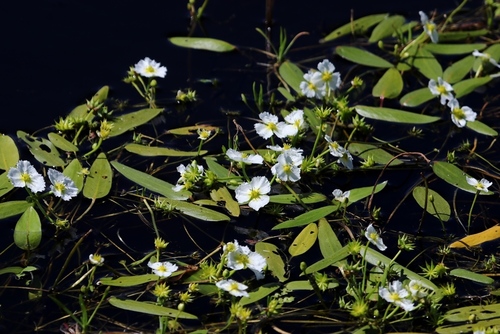
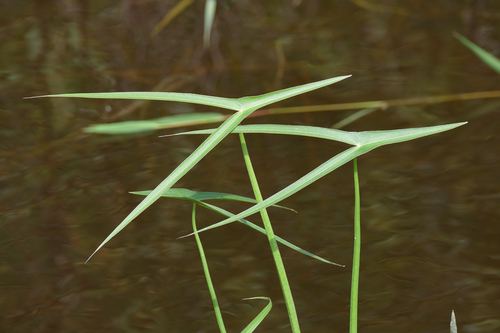
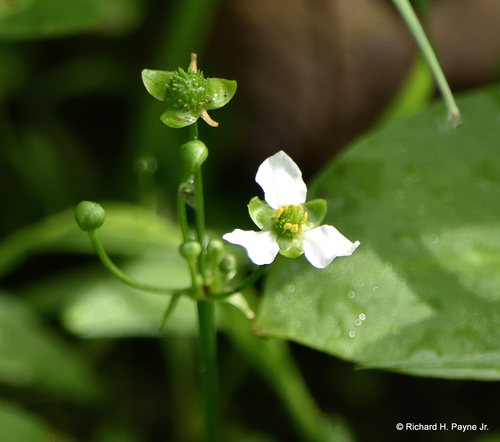
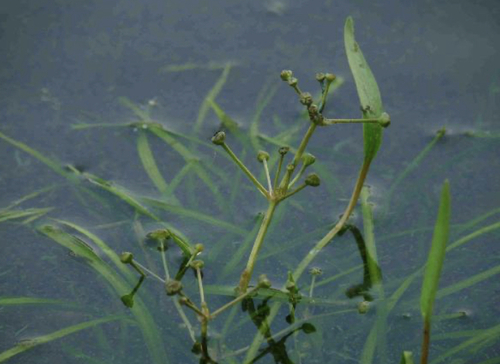
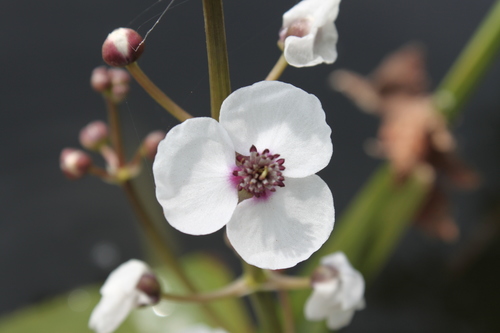
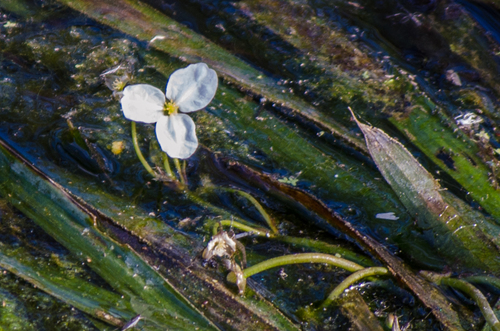
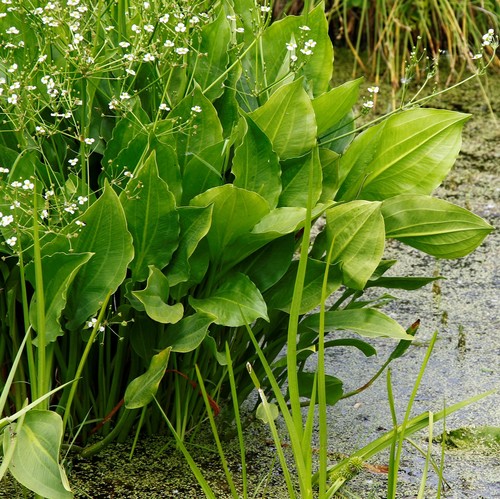
Alisma plantago-aquatica L. is a hairless aquatic plant that grows in shallow water, fresh waters, or on mud. It has a fibrous root system, multiple basal long-stemmed leaves measuring 15–30 centimetres (6–12 inches) long, and a triangular stem that can reach up to 1 metre (3+1⁄2 feet) tall. It produces a branched inflorescence that holds many small flowers, each 1 cm (1⁄2 in) across. Each flower has three round or slightly jagged white or pale purple petals that open in the afternoon, three blunt green sepals, and six stamens. Its carpels often form a flat single whorl. This species flowers from June through August, and each flower develops a ring of seeds as fruit. The species is widely distributed across most of Europe and Asia, ranging from Portugal and Morocco to Japan, Kamchatka, and Vietnam. It is also considered native to northern and central Africa, as far south as Tanzania, and to Australia. It has been reported as naturalized in southern Africa, New Zealand, Alaska, British Columbia, Washington state, and Connecticut. Some sources claim the species is widespread across North America, but these accounts appear to be based on misidentified specimens. The rootstocks of this plant contain starch; they can be eaten after boiling or soaking to remove bitterness. As a general precaution, all aquatic plants should be cooked before consumption to kill harmful parasites. According to the 1934 Flora of the U.S.S.R., a powder made from dried roots of this plant is used in folk medicine to treat rabies, crushed leaves are used to relieve mammary congestion, and fresh leaves are used in homeopathy. The note adds that since this species is often confused with or misidentified as other species in the Alisma genus, the reported medicinal uses may also apply to A. orientale or A. lanceolatum. This plant is commonly called mad-dog weed, a name referencing its reported use to cure rabies, but it should not be confused with Scutellaria lateriflora, also known as mad-dog skullcap, which is sometimes also called mad-dog weed. Alisma orientale is sometimes treated as a variety of this species: A. plantago-aquatica var. orientale. The rhizomes of A. orientale are used as the traditional Chinese medicine ze xie, though this medicine may cause serious or even toxic side effects, including hepatotoxicity, in patients with chronic hepatitis B.