About Alectryon excelsus Gaertn.
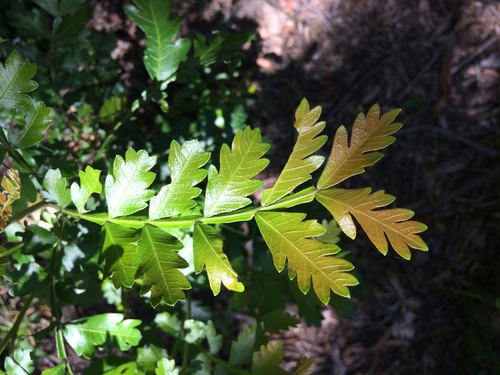
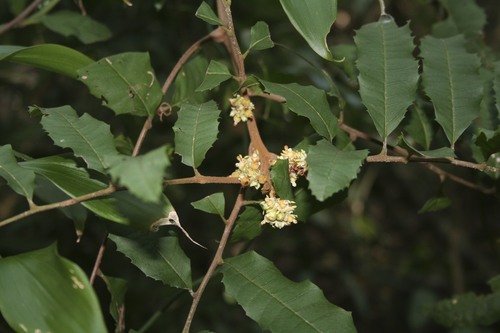
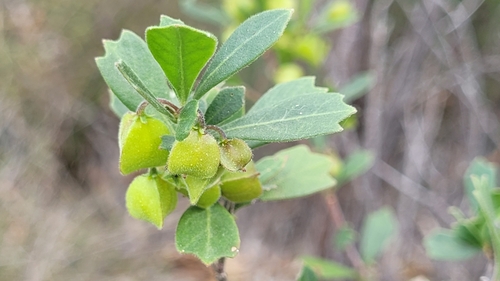
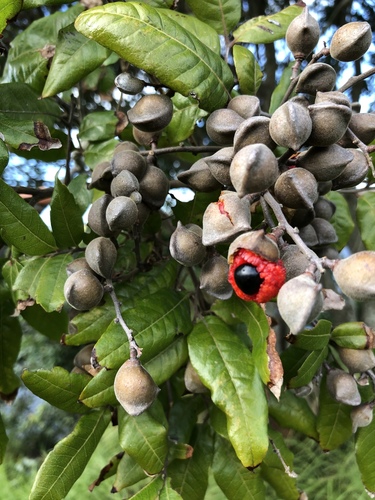
Alectryon excelsus Gaertn., commonly called tītoki, is a sub-canopy tree that grows to 9 metres (30 feet) in height, with a trunk diameter that can reach 50 cm or more. It has a twisting trunk with smooth, dark bark that ranges in colour from pale grey to almost black, plus spreading branches and pinnate leaves that are 10–30 cm long overall. Leaflets on mature trees typically lack marginal teeth, or only have very few shallow, blunt teeth; most adult leaflet margins are downturned. By contrast, juvenile leaflets have prominent teeth and flat edges. A. excelsus produces small purple flowers in spring, with distinct male and female structures: female flowers have a small, non-pollen-producing anther and a short-stalked ovary, while male flowers have long dangling stamens surrounding a vestigial ovary; some individual trees bear only male or only female flowers. Seeds take up to a year to mature. Developing seeds are contained inside a hairy woody capsule covered in dense rusty-brown hairs, which splits open when mature to reveal bright red flesh surrounding a single large black seed; this red and black seed unit is the unpalatable "fruit" of the tree. Alectryon excelsus is native to New Zealand, where it is the only member of the Alectryon genus that occurs naturally. Its native range extends from the North Island south to Bruce Bay in the Westland region of the South Island, and it occurs from sea level up to 600 metres elevation. It is common in lowland and coastal forests of the North Island, and can also be found across much of the South Island. It grows in lowland forest, exposed coastal sites, sandy plains, and wetlands. It is often associated with tawa (Beilschmiedia tawa) on sandy plains. This tree prefers moist, nutrient-rich, fertile alluvial or sandy soils; the most ideal growing sites are fertile, well-drained soils along riverbanks and their associated terraces. It tolerates growing conditions from semi-shade to full sun. It has also been introduced outside its native range, and has been recorded growing along street verges in San Francisco. When the capsule splits open after one year of development, the mature seed is exposed. Seeds either fall to the ground to germinate if conditions are suitable, or are dispersed by New Zealand native birds including tūī, kererū, and kōkako, as well as introduced black birds. Flowering occurs from spring through to early summer. Ecologically, the tree's fruit is commonly eaten by possums and birds, while insects chew its bark and leaves. Deer feed on the leaves of young tītoki trees, and the tītoki fruit borer, a seed parasite, lives inside the seed capsule and destroys the seeds by eating them. In Māori traditional practice, tītoki was traditionally planted by Māori. The fruit pulp was eaten, but it is sour and dry, so it was not a major part of traditional diets and was generally used only as a famine food. The elastic, strong wood was traditionally used to make trainers and wheels. Tītoki seeds were processed to make hinu tītoki, tītoki oil, which was a traditional status symbol. The oil was used as a hair product, added to body paint, thought to repel sandflies, used as a base for perfume, and often steeped with aromatic leaves from plants like tarata. It was also used in traditional rongoā Māori medicine, applied to wounds and used for massage. Traditional oil production involved crushing tītoki seeds with heated stones inside a tourniquet-style flax bag or an elongated woven basket called ngehingehi, which is similar to the Brazilian tipiti; the greenish oil was collected as the bag was squeezed. Early European settlers used tītoki oil for a range of machinery applications, but this practice stopped when the expansion of New Zealand's whaling industry made whale oil more affordable. Early settlers also used tītoki wood to make items like coaches and cabinets. In the 1980s, the Department of Scientific and Industrial Research developed a liqueur made from tītoki berries, promoted for use in desserts and cocktails. The berries add a combination of sweet and astringent flavours to the liqueur, which has been distilled and exported to Australia, Fiji, Japan, and the United Kingdom. Today, tītoki trees are common in suburban New Zealand, where they are widely used for street planting.