About Alectrurus risora (Vieillot, 1824)
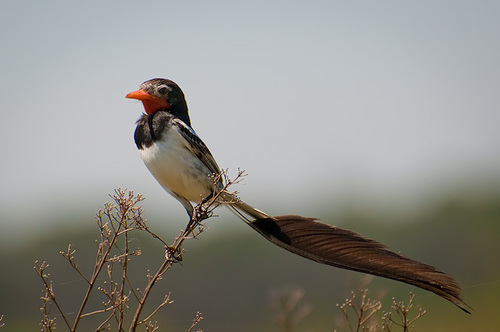
The strange-tailed tyrant (Alectrurus risora) measures about 20 cm (7.9 in) in length, not counting the male’s 10 cm (3.9 in) tail. Adult males in breeding plumage have a mostly black face with white lores and a white supercilium. Their back is mostly black with white scapulars and a gray rump. Their wings are black with white tips on the coverts and white edges on the flight feathers. Their tail is black and very long, with a highly modified outer pair of feathers: the shafts of these feathers are bare at the base, the inner webs of the outer two-thirds are very wide, and they are rotated to the vertical plane and held below the rest of the tail. Males have a wide black band across their breast, and the rest of their underparts are white. Breeding males have a bare pinkish red or pinkish orange throat. Non-breeding males have a white-feathered throat and usually have a shorter tail. Adult females have mottled brown coloration on the head, upperparts, wings, and tail in areas where males are black. The outer pair of their tail feathers are long, with mostly bare shafts and racquets at the end. Their throat is white, their underparts are whitish with a brown band across the breast, and the rest of the underparts often have a buff tinge. Both sexes have a brown iris, a pinkish yellow mandible, a pinkish orange maxilla, and dark gray legs and feet; the feet have an unusually long hind-claw. Sources disagree on the current range of the strange-tailed tyrant. According to the Cornell Lab of Ornithology's Birds of the World, as of 2020 this species is only found from southern Presidente Hayes Department in Paraguay south into northeastern Argentina, as far as Corrientes Province. It formerly ranged further south in Argentina to Buenos Aires Province, and east into southern Brazil and Uruguay. The last documented record of the species in Brazil was in 1974, and the last in Uruguay was in 1986. BirdLife International's (BLI) account is internally inconsistent: its range map matches Cornell's information on the current range, the species' former presence further south in Argentina and in Brazil and Uruguay, and the dates of the last documented records in Brazil and Uruguay. Some of BLI's written account matches the map, but other parts of its text state that the species breeds in all four countries. The South American Classification Committee of the American Ornithological Society classes this species as a vagrant in Brazil and Uruguay. The strange-tailed tyrant primarily lives in a variety of open landscapes including savannas, marshes, and damp grasslands, where it favors areas with tall grass. It also occurs in shrubby areas. It can be found at elevations up to 500 m (1,600 ft).