About Alchornea glandulosa Poepp.
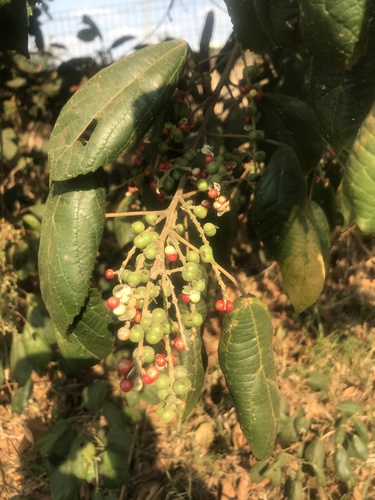
Alchornea glandulosa Poepp. produces fruit that averages around 8.7 mm long by 5.9 mm wide, and typically holds one round seed roughly 4.45 mm in diameter; a second seed only very rarely develops. The single seed protrudes from an aril at the tip of the fruit. When the fruit is ripe, the seedcoat turns bright red, and the fruit somewhat resembles a yew fruit, but with a larger, more prominent seed.
Fruit ripening occurs in the summer months, approximately between September or October and December or January in southern Brazil. During this ripening period, the trees bear fewer leaves than they do at other times of the year, so their bright red fruit are easy to spot.
Due to the fruit's attractive color and its prominent display at the tips of branches, this tree is likely dispersed by birds that eat the fruit and spread its seeds. Perching bird families including tanagers (Thraupidae), thrushes (Turdidae), and tyrant flycatchers (Tyrannidae) are the most commonly observed feeding on the fruit. Some individual birds, like the silver-beaked tanager (Ramphocelus carbo), cut off and eat the seedcoat, discarding the rest of the seed, but most birds swallow the entire fruit. Certain bird species, such as the swallow tanager (Tersina viridis), the pale-breasted thrush (Turdus leucomelas), and especially the sayaca tanager (Thraupis sayaca), seem to be particularly fond of Alchornea glandulosa fruit. The sayaca tanager will even defend A. glandulosa trees with abundant fruit from other similarly sized birds, such as the blue dacnis (Dacnis cayana) or the red-eyed vireo (Vireo olivaceus). It is possible that at least locally, T. sayaca plays a crucial role in the tree's reproduction and survival.
A. glandulosa fruit are also an important food source for certain migratory birds when the birds are in their winter habitats. Specifically, the red-eyed vireo and the white-necked thrush (Turdus albicollis) have been recorded feeding heavily on this fruit, and Swainson's flycatchers (Myiarchus swainsoni) also visit the trees very frequently. However, since Swainson's flycatchers do not greatly enjoy the fruit, they are likely more attracted to insects that live on the tree.
This tree is frequently harvested for timber, and it also serves as a useful honey plant. Its leaves contain compounds that are of medical interest. In folk medicine, Alchornea species are used to treat a range of conditions including assorted skin diseases, diarrhea, inflammations, leprosy, and rheumatism. Scientific studies have confirmed most of these therapeutic effects. Alchornea glandulosa, along with species Davilla elliptica and Davilla nitida, has properties that could be used to treat peptic ulcers. Studies have also found that extracts of certain related species can kill trypanosoma, some bacteria and fungi, and cancer cells; these cytotoxic properties have also been tested in A. glandulosa. Compounds of interest found in A. glandulosa include the phytosterols β-sitosterol and stigmasterol, the terpenoid loliolide, the guanidine alkaloid N-1,N-2,N-3-triisopentenylguanidine, and the phenolic compound corilagin.