About Alchemilla mollis (Buser) Rothm.
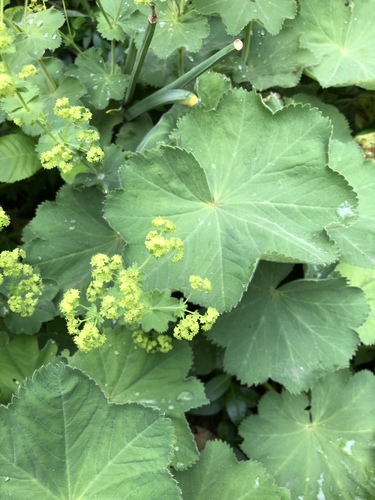
Alchemilla mollis, commonly known as garden lady's-mantle or simply lady's-mantle, is a species of flowering plant in the Rosaceae family. This herbaceous perennial is native to Southern Europe, and is grown as an ornamental garden plant across the world. It reaches a height of 30 to 45 cm (12 to 18 in). Its leaves have palmate venation and scalloped, serrated margins. The plant's stipules are notable for being fused together and leaf-like. Chartreuse yellow flowers grow in dense clusters positioned above the foliage. A. mollis has been awarded the Royal Horticultural Society's Award of Garden Merit. It self-seeds very easily and can become invasive. It is classified as an invasive species in the Faroe Islands, where local authorities encourage the public to uproot the plant when they find it. Alchemilla mollis is often grown as groundcover, and is valued for the distinctive appearance of its leaves during wet weather. Water beads on the surface of its leaves due to their dewetting properties. Alchemists considered these water beads to be the purest form of water, and used this water in their attempts to turn base metals into gold. This practice gives the genus its name, Alchemilla. The Latin specific epithet mollis translates to "soft", referring to the soft hairs covering the plant's leaves. There are conflicting accounts of the plant's historical medicinal use: some sources state that lady's mantle has been used as a herbal remedy for centuries, while other authorities claim it has never been used medicinally. According to these latter sources, confusion has arisen between A. mollis and two other species that do have a documented history of medicinal use: A. alpina (Alpine lady's mantle) and A. xanthochlora.