About Albizia julibrissin Durazz.
Albizia julibrissin Durazz. is a small deciduous tree that grows 5–16 m (16–52 ft) tall, with a broad crown made up of level or arching branches. Its bark is dark greenish grey, and develops vertical stripes as it ages. The leaves are large and frond-like, and are bipinnate: they are divided into 6–12 pairs of pinnae, each of which holds 20–30 pairs of leaflets. Individual leaflets are oblong, measuring 1–1.5 cm (0.4–0.6 in) long and 2–4 cm (0.8–1.6 in) broad. The full mature leaf ranges from 20–45 cm (8–18 in) long and 12–25 cm (5–10 in) broad.
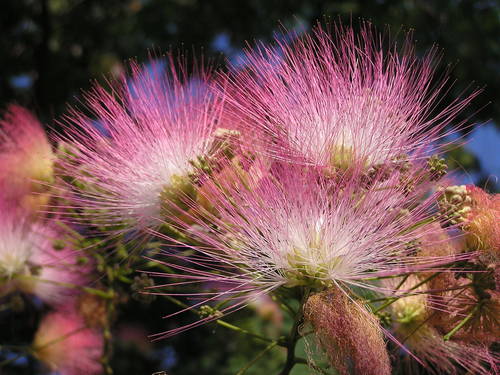
Flowers bloom through the summer in dense inflorescences that look like starbursts of pink silky threads. The true flowers have small calyx and corolla (except for central flowers), arranged in a tight cluster of prominent stamens that are 2–3 cm long. The stamens are white or pink, with a white base. These flowers have been observed attracting bees, butterflies, and hummingbirds. The fruit is a flat brown pod 10–20 cm (4–8 in) long and 2–2.5 cm (0.8–1.0 in) broad, which contains several seeds inside.
There are two recognized varieties of Albizia julibrissin. Albizia julibrissin var. julibrissin is the typical variety that matches the description above. Albizia julibrissin var. mollis differs from the typical variety in that its shoots are densely hairy.
The original native range of this tree spans from Iran (Persia) and the Republic of Azerbaijan to China and Korea. A. julibrissin is widely planted as an ornamental plant in parks and gardens, valued for its fine leaf texture, showy flowers, and attractive horizontal canopy. Additional desirable traits include a fast growth rate, low water requirements, and an ability to grow well when planted in full sun in hot summer climates. It is often planted in semi-arid areas such as California's Central Valley, central Texas, and Oklahoma. While the tree can survive drought, drought conditions cause stunted growth and leave the tree looking unhealthy, so infrequent deep waterings during summer are recommended to support healthy growth and flowering. The broad crown of a mature tree makes it useful for providing dappled shade.
Flower color varies across cultivated forms: A. julibrissin f. alba has white flowers, while other forms have rich red-tipped flowers. Variants with cream or pale yellow flowers have also been reported. New cultivars are becoming available: 'Summer Chocolate' has red foliage that darkens to bronze as it ages, and produces pale pink flowers; 'Ishii Weeping' (also called 'Pendula') has a drooping growth habit.
The wood of the silk tree may be used to make furniture. The species is also reported to be psychoactive, and its flowers are used to make teas. In traditional Chinese medicine, it is classified as an antidepressant.