About Aix galericulata (Linnaeus, 1758)
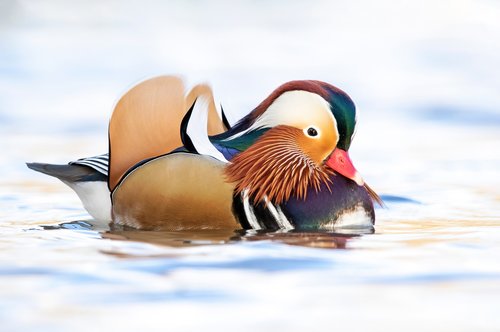
The mandarin duck (Aix galericulata) is a small waterfowl species, with a shorter body and smaller overall size than most dabbling ducks, and it is slightly smaller than its close relative, the American wood duck. Adult males have a small red bill, a large white crescent marking above the eye, a reddish face, and reddish "whiskers". Males have a purple breast with two vertical white bars, ruddy flanks, and two orange sail-shaped feathers on the back, which are modified 12th secondary flight feathers with an enlarged medial vane that stands upright like a boat sail. Females resemble female wood ducks, with greyish-brown plumage, a slender white eye-ring, and a white stripe that extends backward from the eye. Females have a paler underside, a small white flank stripe, and a pale tip on the bill. Both males and females have crests, but the purple crest of the male is far more pronounced. Like many other duck species, males moult into eclipse plumage after the mating season. While in eclipse plumage, males look very similar to females, but can be told apart by their bright yellow-orange or red beak, complete lack of a crest, and a less prominent eye-stripe. Mandarin duck ducklings are almost identical in appearance to wood duck ducklings, and very similar to mallard ducklings. They can be distinguished from mallard ducklings because the eye-stripe of mandarin duck (and wood duck) ducklings stops at the eye, while the eye-stripe of mallard ducklings extends all the way to the bill. The species was once widespread across East Asia, but large-scale exports and destruction of its forest habitat have reduced populations in eastern Russia and China to fewer than 1,000 breeding pairs in each country. Japan is estimated to still hold around 5,000 breeding pairs. Asian populations are migratory, and overwinter in lowland eastern China and southern Japan. A fossil coracoid recovered from the Middle Pleistocene of West Runton, England, was originally assigned to this species and thought to indicate the species once had a much broader distribution. This fossil has since been reinterpreted as belonging to an undetermined member of the subfamily Anatinae. Mandarin ducks frequently escape from captive collections, and a large feral population became established in Great Britain during the 20th century. More recently, small numbers have begun breeding in Ireland, concentrated in the parks of Dublin. Great Britain currently hosts approximately 7,000 feral mandarin ducks. Unlike many introduced species, mandarin ducks have different habitat preferences than native British water birds, and have not caused negative impacts to native wildfowl. They do not compete with other ducks for habitat, and instead occupy a previously vacant ecological niche, so they are generally not considered invasive. However, their expanding range may lead to future competition with the common goldeneye (Bucephala clangula), which also nests in trees. Additional feral populations exist across mainland Europe, with the largest located in the region of Berlin. Isolated feral populations are also found in the United States. Black Mountain, North Carolina hosts a small limited population, and Sonoma County, California is home to a free-flying feral population of several hundred mandarin ducks, descended from ducks that escaped from captivity and reproduced in the wild. In their native breeding range, mandarin ducks prefer dense, shrubby forested edges of rivers and lakes. They mostly occur in low-lying areas, but may breed in valleys at altitudes up to 1,500 m (4,900 ft). In winter, they also occupy marshes, flooded fields, and open rivers. While they prefer fresh water, they may also be found wintering in coastal lagoons and estuaries. In their introduced European range, they live in more open habitat than they do in their native range, around lake edges, water meadows, and cultivated areas with nearby woodland. Mandarin ducks feed by dabbling in water or walking on land. Their diet is mainly made up of plants and seeds, especially beech mast and acorns. They also supplement their diet with snails, insects, and small fish. Their diet changes seasonally: in fall and winter, they eat mostly acorns and grain; in spring, they eat mostly insects, snails, fish, and aquatic plants; and in summer, they eat small worms, small fish, frogs, mollusks, and small snakes. They feed primarily around dawn or dusk, and roost in trees or on the ground during the day.