About Aiolocaria hexaspilota (Hope, 1831)
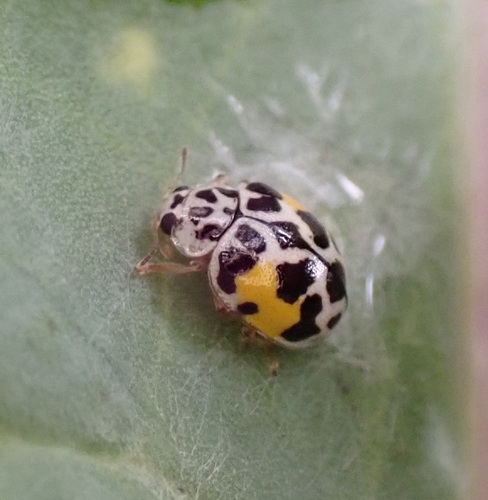
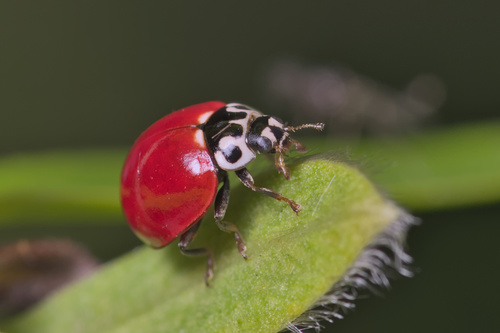
Aiolocaria hexaspilota (Hope, 1831) is a species of beetle belonging to the lady beetle family Coccinellidae. Adult individuals of this species can reach a maximum length of 13 mm. Frederick William Hope first published the species’ scientific name in 1831. Later, in 1860, Victor Motschulsky described and named the same species Aiolocaria mirabilis, unaware that the species had already been identified. Per the Encyclopedia of Life, the oldest published name takes priority and is accepted as the valid name in almost all cases of taxonomic synonymy like this. Entomologists Ivo Hodek of the Czech Institute of Entomology and Edward W. Evans of Utah State University have classified Aiolocaria hexaspilota as a specialized predator of chrysomelids. Entomologist G. I. Savoiskaya observed this beetle actively pursuing larval prey. Ivo Hodek also recorded that the species is univoltine, meaning it produces only one brood per year. In early autumn, Aiolocaria hexaspilota migrates away from sun-exposed forest habitats to well-insolated slopes of rocky hills, or sometimes to buildings. The beetles seek winter shelter in rocky crevices, or will opportunistically use human dwellings, and cluster in aggregations that can contain up to several hundred individuals. Hodek notes that clustering allows the beetles to maintain a body temperature much higher than the surrounding ambient temperature. In spring, the adult beetles mate and disperse.