About Aimophila ruficeps (Cassin, 1852)
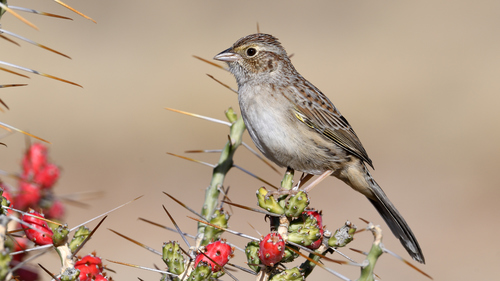
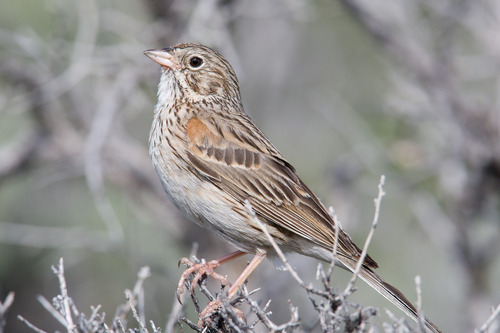
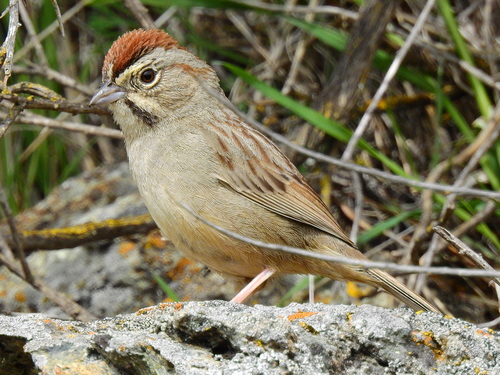
The rufous-crowned sparrow, scientifically Aimophila ruficeps (Cassin, 1852), is a small sparrow that measures 5.25 inches (13.3 cm) in total length. Males are typically larger than females; the species ranges in weight from 15 to 23 g (0.53 to 0.81 oz), with an average weight of 19 g (0.67 oz). It has a streaked dark brown back, gray underparts, short rounded brown wings that lack contrasting wingbars, and a long, rounded brown tail. Its face and the supercilium (the area above the eye) are gray, with a brown or rufous streak extending from each eye and a thick black streak on each cheek. The crown, the feature that gives the species its common name, ranges from rufous to chestnut, and some subspecies have a gray streak running through the center of the crown. It has a yellow, cone-shaped bill, a white throat with a dark stripe, and pink-gray legs and feet. Adult males and females have similar overall appearance. Juvenile rufous-crowned sparrows have a brown crown and numerous streaks on the breast and flanks during spring and autumn. The rufous-crowned sparrow's song is a short, fast, bubbling series of chip notes that often accelerates near the end. Its common calls include a nasal chur and a thin tsi; when threatened or separated from its mate, it produces a repeated dear-dear-dear call.
This species occurs in the southwestern United States and Mexico, ranging from sea level up to 9,800 feet (3,000 m) in elevation, though most individuals are found between 3,000 and 6,000 feet (910 and 1,830 m). Its range extends through California, southern Arizona, southern New Mexico, Texas, and central Oklahoma, south along Baja California and through western Mexico to southern Puebla and Oaxaca. In the midwestern United States, it reaches as far east as a small area of western Arkansas, and also occurs in a small region of northeastern Kansas, which is its most northeastern habitat. The species' range is discontinuous, consisting of many small, isolated populations. The rufous-crowned sparrow is non-migratory, though mountain-dwelling subspecies will descend to lower elevations during severe winters. Males maintain and defend territories year-round. It inhabits open oak woodlands, dry uplands with grassy vegetation and shrubs, and is often found near rocky outcroppings. It also occurs in coastal scrublands and chaparral, and thrives in open areas cleared by burning.
In California chaparral, the average territory size for this species ranges from 2 acres (0.81 ha) to 4 acres (1.6 ha). Territory density varies by habitat: 2.5 to 5.8 territories per 99 acres (40 ha) of 3- to 5-year-old burned chaparral, and 3.9 to 6.9 territories per the same area of coastal scrubland. One mated pair typically occupies a single territory, though unpaired birds have been observed sharing a territory with a mated pair. The rufous-crowned sparrow is awkward in flight, and primarily moves by running and hopping. It may forage in pairs during the breeding season, and in family-sized flocks in late summer and early autumn. During winter, it can occasionally be found in loose mixed-species foraging flocks. Predators of adult rufous-crowned sparrows include house cats and small raptors such as Cooper's hawks, sharp-shinned hawks, American kestrels, and white-tailed kites. Nest contents may be raided by a range of species including mammals and reptiles such as snakes, though nest predation has not been directly observed. Nesting sparrows use three distinct displays to distract potential predators: the rodent run, the broken wing, and tumbling off the bush. In the rodent run display, the bird lowers its head, neck, and tail, holds its wings out, fluffs its feathers, runs rapidly, and gives a continuous alarm call to draw predators away. In the broken wing display, the sparrow drops one wing to the ground to imitate an injury, hops away from the nest while dragging the disabled wing, and stops the display and escapes once the predator has been led away. In the tumbling off the bush display, an adult falls from the top of a bush to draw a nest predator toward itself instead of toward the nest. The longest recorded lifespan for a rufous-crowned sparrow is three years and two months. Two tick species, Amblyomma americanum and Ixodes pacificus, are known to parasitize this sparrow.
The rufous-crowned sparrow breeds in sparsely vegetated scrubland. Males attract mates by singing from regular positions along the edge of their territories throughout the breeding season. The species is monogamous, with individuals taking only one mate at a time, and pairs often remain together for multiple years. When two singing males encounter one another, they first raise their crowns and face the ground to display this feature; if this does not cause the intruder to leave, they stiffen their body, droop their wings, raise their tails, and hold their head straight forward. Males guard their territories year-round. While the exact start of the breeding season is not confirmed, the earliest observed observation of a sparrow carrying nesting material was March 2 in southern California. The female builds a bulky, thick-walled open-cup nest, most often on the ground, and occasionally in a low bush up to 18 inches (46 cm) above ground. The nest is constructed from dried grasses and rootlets, and sometimes includes bark strips, small twigs, and weed stems. Nests are well hidden, built near bushes, tall grasses, or overhanging rock with concealing vegetation. Sparrows tend to return to the same nesting site for many years after their initial selection. Clutch size ranges from two to five eggs, and the species typically raises only one brood per year, though some individuals in California have been recorded raising two or even three broods annually. Replacement clutches may be laid if an initial nesting attempt fails. Eggs are unmarked pale bluish-white. Very occasionally, broods are parasitized by brown-headed cowbirds. Incubation lasts 11 to 13 days, and is performed exclusively by the female. Hatchlings are born naked, and quills do not begin to develop until the third day after hatching. Only females brood nestlings, though both parents bring whole insects to feed the young. Young sparrows leave the nest after 8 or 9 days, at which point they are still incapable of flight but can run through underbrush, and continue to be fed by their parents. Juveniles typically leave their parents' territory and move into adjacent habitat in autumn or early winter. Reproductive success varies strongly with annual rainfall, and is highest during wet El Niño years. This is because cool rainy weather reduces the activity of snakes, the main predator of the sparrow's nests.