About Ailanthus altissima (Mill.) Swingle
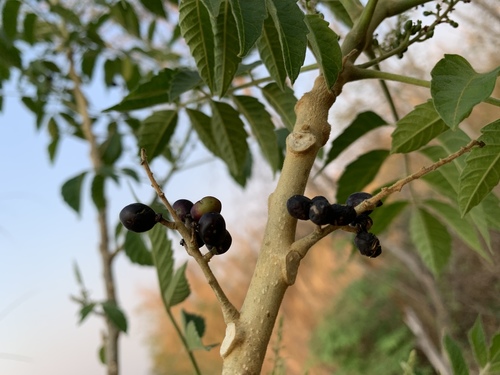
Ailanthus altissima (Mill.) Swingle, commonly called tree of heaven, is a medium-sized tree that typically reaches 17 to 27 m (60 to 90 ft) in height, with a diameter at breast height of around 1 m (3 ft). Young trees have smooth, light grey bark that becomes rougher with light tan fissures as it ages. Twigs are stout, reddish or chestnut-colored, and range from smooth to lightly pubescent. They have visible lenticels and heart-shaped leaf scars (the marks left after a leaf falls), with many small bundle scars (where leaf veins connected to the twig) along the scar edges. Buds are finely pubescent, dome-shaped, and partially hidden by the leaf petiole during the growing season, but are fully visible in the dormant season at the sinuses of the leaf scars. Branches are smooth and lustrous, ranging from light to dark gray, with raised lenticels that develop into fissures as the branch ages, and the branch tips become pendulous. All parts of the plant have a distinct strong odor often compared to peanuts, cashews, or rotting cashews.
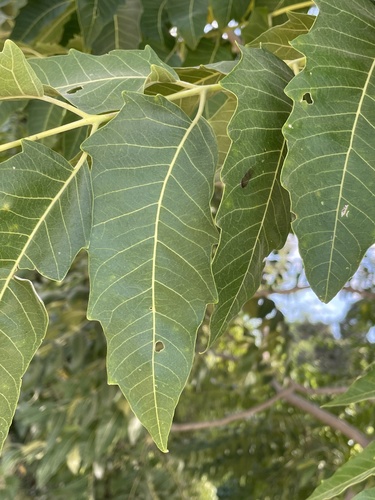
The leaves are large, pinnately compound (either odd- or even-pinnate) and arranged along the stem. They measure 30 to 90 cm (1 to 3 ft) in length, and hold 10 to 41 leaflets arranged in pairs, with the largest leaves growing on vigorous young sprouts. Newly emerged spring leaves are bronze, then quickly turn medium to dark green as they mature. The leaf rachis is light to reddish-green with a swollen base. Leaflets are ovate-lanceolate with entire margins, are somewhat asymmetric, and are occasionally not directly opposite each other. Each leaflet is 5–18 cm (2–7 in) long and 2.5–5 cm (1–2 in) wide, with a long tapering tip. The base of each leaflet has two to four teeth, each with one or more glands at the tooth tip. The upper surface of leaflets is dark green with light green veins, while the lower surface is a paler whitish-green. Petioles are 5–12 millimetres (0.2–0.5 in) long. Lobed leaflet bases and the presence of glands distinguish Ailanthus altissima from similar sumac species.
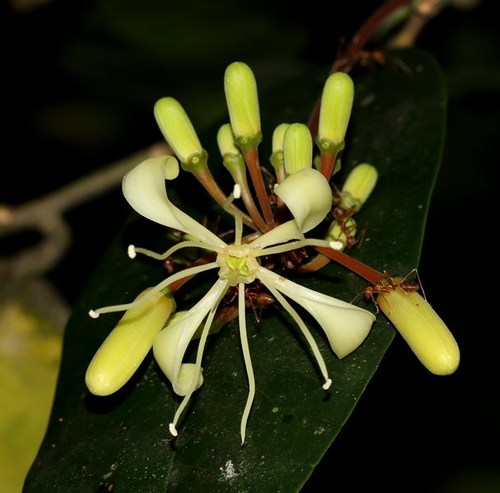
Flowers are small and borne in large panicles up to 50 cm (20 in) long at the tips of new shoots. Individual flowers range from yellowish green to reddish, with five petals and five sepals. Sepals are cup-shaped, lobed, and united, while petals are valvate, meaning they meet at their edges without overlapping, and are white and hairy on the inner surface. Flowering occurs from mid-April in the southern part of its range to July in the north. Ailanthus altissima is dioecious, meaning male and female flowers grow on separate individual trees. Male trees produce three to four times more flowers than females, making male plants more visible. Male plants also release a foul-smelling odor while flowering to attract pollinating insects. Female flowers have 10 sterile stamens called stamenoids (rarely five, due to abortion), with heart-shaped anthers. The pistil is made of five unfused free carpels, each holding one ovule. The styles are united and slender, ending in star-shaped stigmata. Male flowers look similar to female flowers, but lack a pistil and have functional stamens, each topped with a globular anther and a glandular green disc.
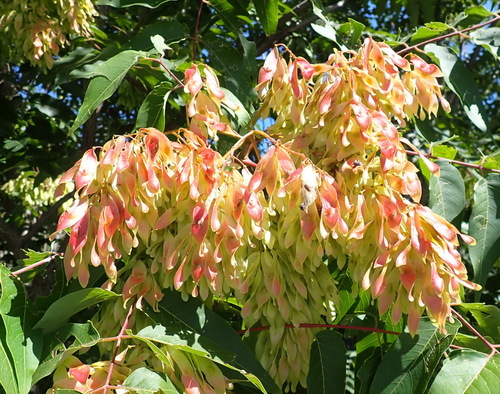
Fruits grow in clusters, and like the fruits of common ash (Fraxinus excelsior), they ripen to a bright reddish-brown color in September. A single fruit cluster can hold hundreds of seeds. Seeds produced by female trees are 5 mm (0.2 in) in diameter, each enclosed in a samara that is 2.5 cm (1 in) long and 1 cm (0.4 in) wide. Samaras form between July and August, and can remain on the tree until the following spring. The large samara is twisted at the tip, which makes it spin as it falls, aiding wind dispersal, and also improves buoyancy for long-distance dispersal by water. Primary wind dispersal and secondary water dispersal are usually positively correlated in A. altissima, since most samara morphological traits affect both dispersal modes in the same way. The only exception is samara width, which affects the two dispersal modes in opposite ways, allowing variation in dispersal strategies between individual trees. Female trees can produce very large numbers of seeds, normally around 30,000 seeds per kilogram of tree biomass, and total seed production can be estimated by measuring the tree's diameter at breast height.
Ailanthus altissima is native to northern and central China, Taiwan, and northern Korea. Fossil records show the species grew as far west as Poland and Turkey during the Miocene period, more than 5 million years ago. In Taiwan, it occurs as the variety takanai. In China, it is native to every province except Hainan, Heilongjiang, Jilin, Ningxia, and Qinghai. It has been introduced to many regions worldwide, and is found on every continent except Antarctica. The tree prefers moist, loamy soils, but is adaptable to a very wide range of soil conditions and pH values. It is drought-tolerant, but cannot tolerate flooding, and also does not grow well in deep shade. In China, it is often found in limestone-rich areas. It grows in a wide range of climatic conditions, and occurs at high altitudes in its native range in Taiwan. It is widespread across virtually the whole United States, but is especially common in arid regions bordering the Great Plains, very wet regions of the southern Appalachians, cold areas of the lower Rocky Mountains, and throughout most of the California Central Valley, where it forms dense thickets that displace native plants. Prolonged cold and snow cover cause above-ground dieback, but trees resprout from their roots.
Tree of heaven is an opportunistic plant that grows best in full sun and disturbed areas. It spreads aggressively both by seed and vegetatively through root sprouts, and regrows rapidly after being cut. It is a shade-intolerant tree and cannot compete in low-light environments, though it is sometimes found growing alongside hardwoods; this indicates it was already present when the forest stand became established. However, a study in an old-growth hemlock–hardwood forest in New York found that Ailanthus altissima can successfully compete with native trees in canopy gaps where only 2-15% of full sun is available. The same study described the tree as using a gap-obligate strategy to reach the forest canopy: it grows rapidly over a very short period rather than growing slowly over a long period. It is a short-lived tree, with most individuals living 30 to 50 years, though exceptional healthy, seed-producing individuals over 100 years old have been documented.
Among tree species, Ailanthus altissima is one of the most tolerant of pollution, including sulfur dioxide, which it absorbs in its leaves. It can withstand cement dust and fumes from coal tar operations, and resists ozone exposure relatively well. High concentrations of mercury have been found accumulated in the plant's tissues. It has been used to revegetate areas affected by acid mine drainage, and has been shown to tolerate pH as low as 4.1, which is approximately the pH of tomato juice. It can withstand very low phosphorus levels and high salinity levels. Its strong drought tolerance comes from effective water storage in its root system. It is frequently found in areas where very few other tree species can survive. Its aggressive roots are strong enough to damage subterranean sewers and pipes. Along highways, it often forms dense thickets where very few other tree species can grow, largely because it produces toxins to prevent the growth of competing plants.
Ailanthus trees produce an allelopathic chemical called ailanthone, which inhibits the growth of other plants. The highest concentration of this inhibitor is found in the bark and roots, but it is also present in the leaves, wood, and seeds. One study found that a crude extract of root bark prevented 50% of sampled garden cress (Lepidium sativum) seeds from germinating. The same study tested the extract as an herbicide on garden cress, redroot pigweed (Amaranthus retroflexus), velvetleaf (Abutilon theophrasti), yellow bristlegrass (Setaria pumila), barnyard grass (Echinochloa crusgalli), Sugar Snap pea (Pisum sativum), and Silver Queen maize (Zea mays). The extract killed nearly 100% of seedlings, with only velvetleaf showing some resistance. Another experiment found that a water extract of the chemical was either lethal or highly damaging to 11 North American hardwoods and 34 conifers, with white ash (Fraxinus americana) being the only species not adversely affected. The chemical does not harm A. altissima's own seedlings, indicating the species has a defense mechanism to prevent autotoxicity. Resistance to the chemical in other plant species increases with repeated exposure; populations with no prior exposure are the most susceptible, and seeds produced by exposed plants are more resistant than seeds from unexposed plants.
Tree of heaven is a very rapidly growing tree, possibly the fastest-growing tree in North America. Growth of 1 to 2 metres (3 to 7 ft) per year for the first four years is normal. Shade greatly reduces growth rates. Older trees grow much slower, but still grow faster than most other trees. Studies have found that Ailanthus trees in California grow faster than those on the East Coast of the United States, and American trees in general grow faster than Chinese trees.
In northern Europe, tree of heaven was not considered naturalized in cities until after the Second World War. This is attributed to its ability to colonize rubble areas from destroyed buildings, where most other plants cannot grow. The warmer microclimate of cities also provides more suitable habitat than surrounding rural areas. It is thought the tree requires a mean annual temperature of 8 °C (46 °F) to grow well, which limits its spread into more northern and higher-altitude areas. For example, a study in Germany found tree of heaven growing in 92% of densely populated areas of Berlin, 25% of its suburbs, and only 3% of rural areas outside the city. In other parts of Europe with milder climates, it can flourish outside cities, and has colonized natural areas in Hungary; it is considered a threat to biodiversity at that country's Aggtelek National Park.
Several Lepidoptera species use Ailanthus leaves as food, including the Indian moon moth (Actias selene), cobra moths (Attacus spp.), and the common grass yellow (Eurema hecabe). In North America, it is the host plant for the ailanthus webworm (Atteva aurea), an ermine moth native to Central and South America that originally used other mostly tropical Simaroubaceae species as hosts. In the United States, it has been found hosting the brown marmorated stink bug and the Asiatic shot-hole borer (Euwallacea validus). The spotted lanternfly (Lycorma delicatula) prefers Ailanthus as a host to complete its lifecycle, but does not depend on it. The insect may absorb quassinoid compounds from feeding on the tree to use as a chemical defense against birds, and the wide distribution of Ailanthus supports the lanternfly's rapid spread outside of China. Spotted lanternfly is an invasive insect first recorded in the United States in 2014, and has spread from southeastern Pennsylvania to 17 eastern states, causing significant damage to orchards, vineyards, and forests. Since Ailanthus is a preferred host for spotted lanternfly, removing Ailanthus trees is an important management step to reduce lanternfly populations in an area. Because lanternflies are attracted to Ailanthus, the trees are also used to detect new lanternfly populations in previously uninfested areas. Ailanthus trees are also used in integrated pest management: trap trees are treated with insecticide to reduce lanternfly populations while minimizing impacts on other species. In its native range, Ailanthus trees are associated with at least 32 species of arthropods and 13 species of fungi.
According to Elbert Luther Little, the roots of Ailanthus altissima are poisonous to humans. Other plant parts are also suspected of being poisonous, and illness has been reported after ingesting plant parts or water contaminated by the tree's flowers. In rare cases, workers clearing heavily infested areas have developed myocarditis (inflammation of the heart) from exposure to Ailanthus sap. However, a controlled feeding experiment lasting over 100 days found the leaves are not poisonous to goats. Goats do avoid the tree's bark, but feeding bark extracts to goats caused no ill effects.
Ongoing research on verticillium wilt, caused by Verticillium nonalfalfae, has identified a strain of the wilt that preferentially attacks Ailanthus trees, but as of 2024 no commercial bioherbicide using this strain has been developed. Due to tree of heaven's weedy growth habit, landowners and other organizations often use various control methods to keep its populations in check. For example, the city of Basel in Switzerland runs an eradication program for the tree. Eradication can be very difficult. Control methods can be physical, thermal, managerial, biological, or chemical, and combining multiple compatible methods is usually most effective. All methods have some benefits and drawbacks, but the most effective approach is generally a mix of chemical and physical control: foliar or basal herbicides are applied to kill existing trees, while seedlings are either hand pulled or mowed to prevent new growth.
In addition to being grown as an ornamental plant, tree of heaven is used for its wood, and as a host plant to feed silkworms of the moth Samia cynthia, which produces a coarse, hard-wearing silk that cannot take dye. This silk is known by several names: pongee, eri silk, and Shantung silk, with the last name coming from China's Shandong province, where this silk is often produced. Production of this silk is particularly well known in the Yantai region of Shandong. The moth has also been introduced to the United States. The pale yellow, close-grained, satiny wood of Ailanthus was historically used in cabinet work. It is flexible and well-suited for making kitchen steamers, which are used in Chinese cuisine to cook mantou, pastries, and rice. Zhejiang province in eastern China is most famous for producing these steamers. Across most of its range, tree of heaven is considered a good source of firewood, as it is moderately hard and heavy, and readily available. The wood is also used to make charcoal for culinary use. However, there are drawbacks to using the wood as lumber. Because trees grow very quickly in their first few years, the inner and outer wood of the trunk have uneven texture, which can cause the wood to twist or crack during drying. Drying techniques have been developed to prevent this cracking, allowing the wood to be harvested commercially. Although live trees have very flexible wood, the wood becomes quite hard once properly dried.
Tree of heaven is a popular ornamental tree in China, valued for its tolerance of difficult growing conditions. It was once very commonly cultivated in both Europe and North America, but its popularity declined, especially in the United States, due to the unpleasant odor of male blossoms and its weedy growth habit. Growers previously avoided the odor problem by only selling female (pistillate) plants, since only males produce the strong odor, but female plants produce very high numbers of seeds. In 1982, noted American horticulturist and University of Georgia professor Michael Dirr reported meeting a grower who could not find any buyers for Ailanthus. Dirr further wrote, with his emphasis: For most landscaping conditions, it has no value as there are too many trees of superior quality; for impossible conditions this tree has a place; selection could be made for good habit, strong wood and better foliage which would make the tree more satisfactory; I once talked with an architect who tried to buy Ailanthus for use along polluted highways but could not find an adequate supply.
In Europe, however, the tree is still used in gardens to some degree, as it is generally not as invasive there as it is in North America. In the United Kingdom, it is especially common in London's squares, streets, and parks, and is also frequently found in gardens of southern England and East Anglia. It becomes rare further north, occurring only infrequently in southern Scotland, and is also rare in Ireland. In Germany, it is commonly planted in gardens. Ailanthus is short-lived, and trunks over 60 to 90 centimeters (2 to 3 ft) often become hollow with no outward signs before they are destroyed in high winds. Notable cultivars include Hongye (Chinese for "red leaves", which has attractive vivid red foliage), Thousand Leaders, Metro (a male cultivar with a tighter than usual crown and a less weedy growth habit), Erythrocarpa (which produces striking red fruits), and Pendulifolia (which has much longer leaves that hang elegantly).
Nearly every part of A. altissima has had various uses in Chinese traditional medicine. In the 19th century, American herbalists considered a tincture made from the root bark to be useful, but it was also known at that time to cause nausea, vomiting, and muscle weakness. The plant contains phytochemicals including quassin, saponin, and ailanthone. Its strong noxious odor has been linked to nausea and headaches, and contact dermatitis has been reported in both humans and sheep; exposed sheep develop weakness and paralysis. The plant contains a quinone irritant, 2,6-dimethoxybenzoquinone, as well as quassinoids.