About Ahaetulla nasuta (Lacépède, 1789)
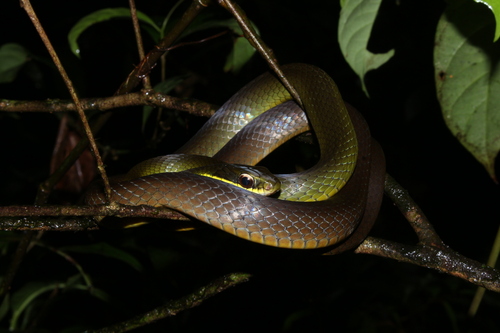
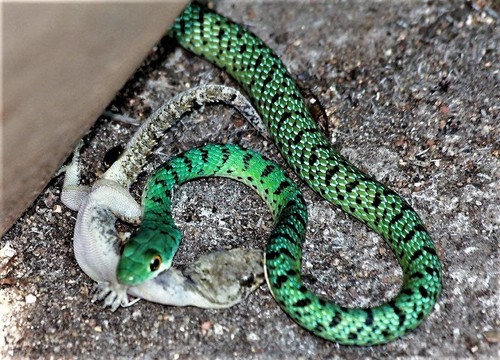
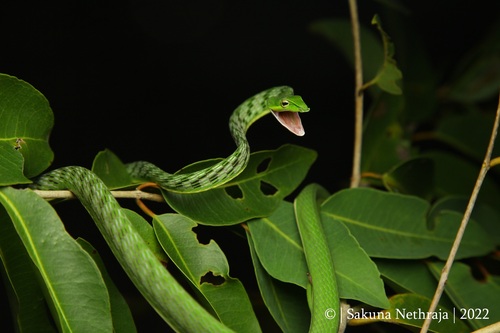
Ahaetulla nasuta (Lacépède, 1789) is a long, slender snake that can grow up to 1.9 m (6 ft 3 in) in length, and has a very pointed snout. Its base color ranges from bright green to pale brownish, with a yellow line running along each side of the lower surface of its body, and black-and-white patterned interstitial skin between its scales. This is the only snake species known to have horizontal pupils, unlike the vertical slit pupils that are typical for many viper species.
Longstanding taxonomic confusion has led to repeated changes in how the range and classification of A. nasuta are defined. The species was historically thought to have a broad distribution extending from Sri Lanka to peninsular India (including the Western Ghats), with an additional separate disjunct population in Southeast Asia. Recent phylogenetic studies have confirmed that A. nasuta is paraphyletic as originally defined, and requires formal taxonomic revision. A 2017 study reclassified the former subspecies Ahaetulla nasuta anomala as a separate full species, Ahaetulla anomala; however, a 2020 study later found that A. anomala may actually be the same species as Ahaetulla oxyrhyncha. A 2019 study's cladogram also showed Ahaetulla nasuta to be paraphyletic.
A 2020 phylogenetic study reaffirmed that A. nasuta as originally described is paraphyletic, and confirmed that the original broad classification of A. nasuta actually forms a species complex. This study restricted the definition of the "true" originally described A. nasuta to the wet zone of Sri Lanka, which includes Sri Lanka's lowland and montane rainforests. Four populations from India's Western Ghats that were formerly grouped under A. nasuta were split into four separate species: A. borealis, A. farnsworthi, A. isabellina, and A. malabarica. The large-bodied form from lowland peninsular India (and possibly the dry zone of northern Sri Lanka), also formerly placed in A. nasuta, was reidentified as A. oxyrhyncha, which is actually more closely related to A. pulverulenta and A. sahyadrensis than to A. nasuta. The disjunct Southeast Asian population was assigned to an as-yet undescribed species, tentatively called Ahaetulla cf. fusca, which is the sister species to Ahaetulla laudankia.
Prior to this 2020 study by Mallik et al., A. nasuta was considered widely distributed across India and Southeast Asia. Following the study's taxonomic revisions, the confirmed distribution of true A. nasuta is restricted to Sri Lanka. Within this range, the species inhabits lowland forest and bush, and is often found near streams and human settlements.