About Ahaetulla isabellina (Wall, 1910)
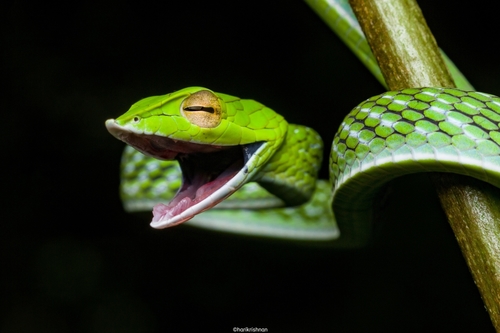
This species, Ahaetulla isabellina (Wall, 1910), has a very slender body, typically bright green with faint blue patches; some specimens are uniformly colored olive to light brown. The rostral scale, infralabials, and midsection along the belly are light green to light blue, and a yellow ventral stripe may sometimes be present along the notched ventral keels. The skin between scales is white, marked with black and white anteriorly-converging bars on the forebody that become reddish along the hindbody. The tail and subcaudal scales are green. Eye color ranges from yellow to orange, with light brown marbled patterning. The pupil is horizontal, and has a ring of light blue or yellow around it. Adult individuals can reach a total length of up to 1 meter. The species has documented intraspecific variation in its scalation: ventrals number 167–183, and are notched with keels; divided subcaudals number 159–167 in males and 105–149 in females; the anal scale is divided. Body scale rows count 15-15–13/11, and these are smooth, obliquely arranged scales. Supralabials number 8–9, with either the 5th or 6th supralabial in contact with the eye; the 4th supralabial is divided. Infralabials number 8–9. Pre-suboculars number 1 or 2; there is 1 pre-ocular on both the left and right side. Postoculars number 1 or 2; sub-oculars are absent. Temporals are arranged 1+2 or 2+2. This species is distributed across the southern Western Ghats in Tamil Nadu and Kerala, located south of the Palghat Gap, ranging from the Anaimalai Hills south to the Kalakkad reserve forest area. Further research is required to confirm the full southern extent of the species' range. It inhabits evergreen forests of the Western Ghats at elevations from approximately 550 m to 1475 m above sea level.