About Agrotis trux Hübner
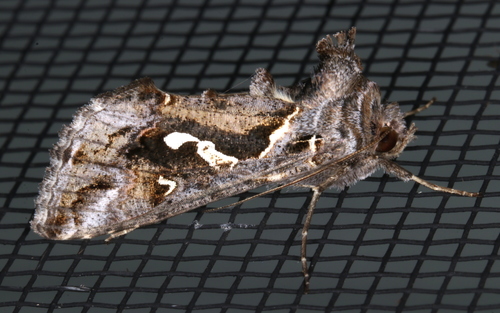
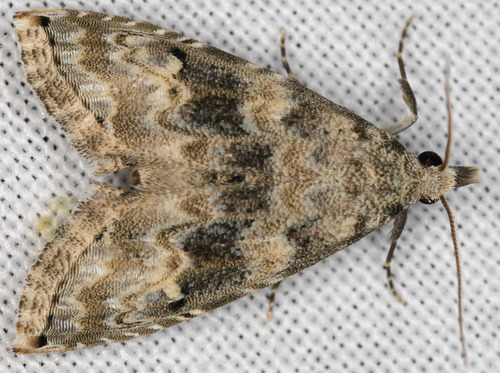
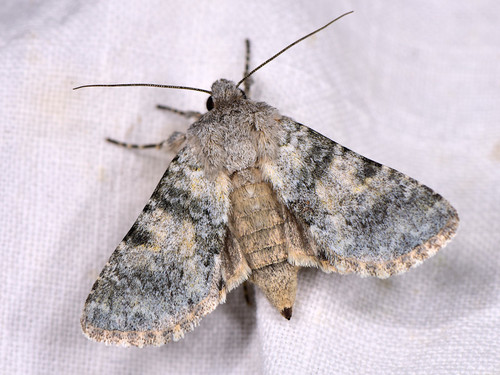
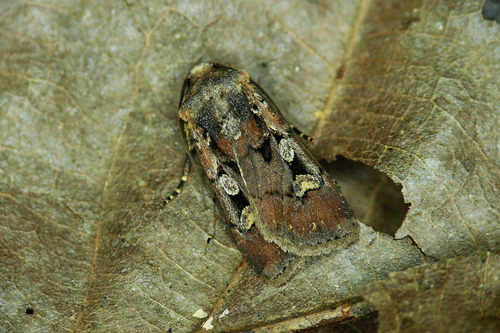
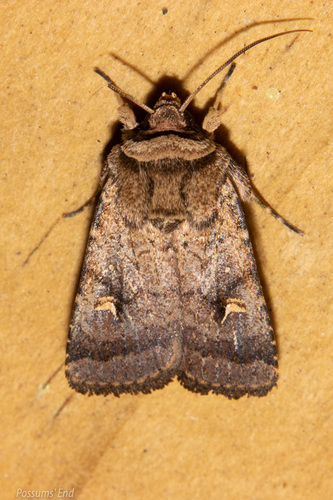
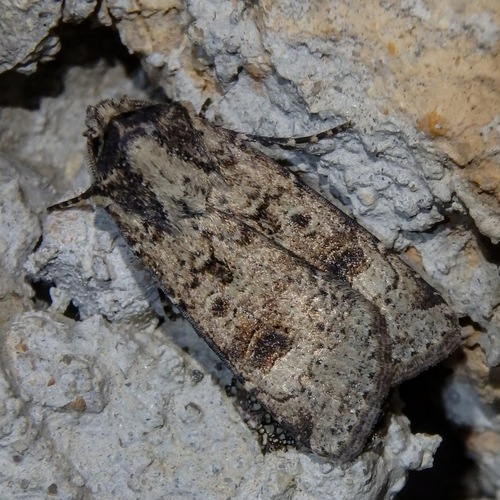
This species of moth has a wingspan of 35–42 mm. Its forewings are ochreous grey, with dappling and striping, and are often suffused with dark fuscous, especially in females. The claviform stigma has a black edge, the large reniform stigma is filled with black, and the small, round orbicular stigma has a pale ring. The fringe is rufous. The hindwings are dull whitish with a fuscous terminal suffusion that is broader in females; alternatively, hindwings may have a curved row of dark dashes on the veins with no suffusion. Agrotis trux Hübner is a variable species found across southern Europe, Algeria, the Canary Islands, southern Russia, and Asia Minor. Several aberrations and subspecies are recorded: In aberration olivina Stgr., the forewing is smooth olive grey with little to no irroration (sprinkling), and markings are distinctly red brown. In aberration terranea Frr., the suffusion and markings are rufous. In aberration amasina Stgr., the moth is fuscous grey with a blackish median shade, and the ground colour is darker in females. Subspecies lunigera Stph. has forewings that are fuscous or pale grey, patterned with yellowish; its lines are distinct, the orbicular stigma is small, the reniform stigma is large and blackish, and the claviform stigma is black. This subspecies occurs on the south coast of England and Ireland. In aberration pallida Tutt, the moth is whitish grey with a slaty tinge, and not sprinkled with yellow. In aberration virgata Tutt, there is a dark shade before the reniform stigma, and the outer third of the wing is dark. In aberration suffusa Tutt, the entire forewing is suffused with blackish grey, except for the pale orbicular stigma and a small patch between the reniform stigma and the outer line. In aberration nigra Tutt, the forewing is unicolorous blackish, with lines and stigmata that are more intensely dark, and the orbicular stigma is sometimes visible. In aberration rufescens Tutt, the moth matches the typical form but is tinged reddish across the whole body.