About Agrotis infusa Boisduval, 1835
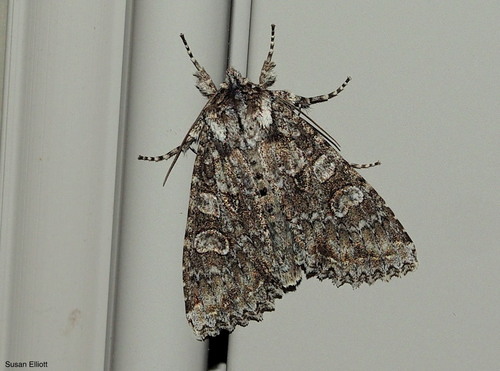
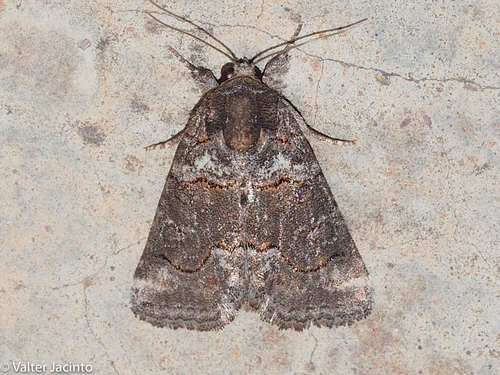
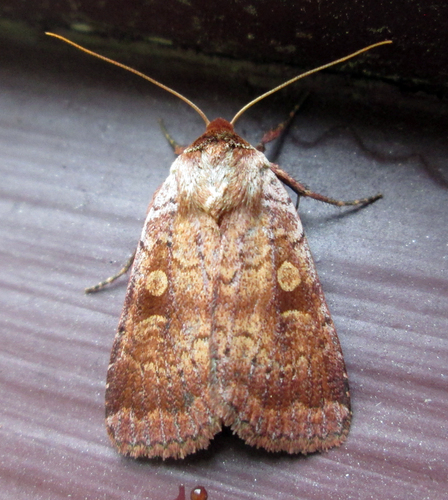
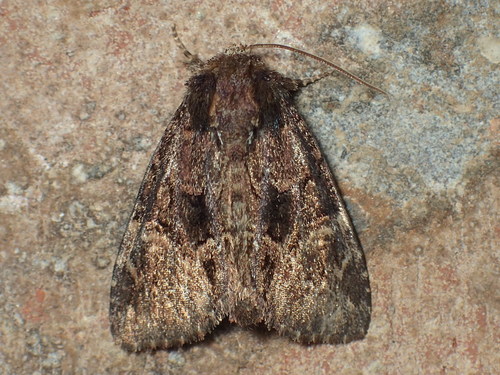
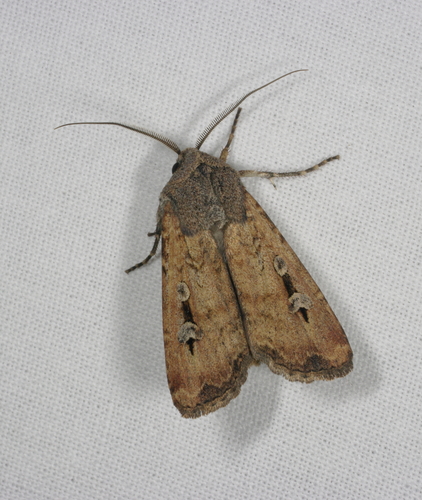
Agrotis infusa (the bogong moth, described by Boisduval in 1835) has distinct physical traits across its life stages. Adult bogong moths are overall dark brown, with a dark stripe broken by two light-colored spots on the wings that sets them apart from other moth species. There are visual differences between the migratory and nonmigratory forms of the species: migratory moths have brown hind wings, while nonmigratory moths have paler hind wings. Adult bogong moths have a wingspan of 40–50 mm (1.6-2.0 in), a body length of around 25–35 mm (1-1.4 in), and an average adult weight of 0.326 grams. Bogong moth eggs are dome-shaped with vertical ridges, measuring 0.7 mm (0.03 in) in diameter and 0.4 mm (0.02 in) in height. Newly hatched caterpillars are pale in color, but develop green bodies with pale and dark stripes and spots as they grow and feed. Larvae reach a maximum length of 50 mm (2.0 in).
Bogong moth populations are primarily found across southern Australia, west of the Great Dividing Range. Both nonmigratory and migratory populations of the species occur in these regions, and the two forms differ in their seasonal presence across the area. Adult moths lay eggs in New South Wales, southern Queensland, and northern Victoria, where larvae hatch and develop to adulthood. In spring, bogong moths migrate south or east toward the Australian Alps to undergo summer aestivation, and can be found in the Australian Capital Territory and Bogong Mountains. Strong winds can blow moths off their migration route, so they can also be found as far away as Tasmania and New Zealand.
The bogong moth life cycle begins when adults return from aestivation sites during autumn migration, then lay up to 2000 eggs in soil or on plants near soil. Egg incubation time depends on temperature, and eggs hatch 4–7 days after being laid in laboratory conditions. Bogong moth larvae go through six instars. They grow slowly through the first three instars, and take until June to develop over the winter. In spring, larvae grow quickly and reach their final instar in late August to September, shortly before migration begins. Larvae are nocturnal, and feed on plants in their breeding grounds at night. They pupate in soil chambers 20–150 mm (0.8-7.9 in) deep. Pupation lasts 3–11 weeks depending on temperature and environment. Pupae are 20 mm (0.8 in) long and have a shiny, brown appearance. After adults emerge from the soil chambers, they begin migration shortly after.
Adult bogong moths are also nocturnal, with different seasonal behaviors. In spring, they feed and migrate south, then enter aestivation (a period of dormancy) during the summer. At this stage, adults are not yet sexually mature, and do not actively seek food during aestivation. In autumn, the moths migrate back to their breeding grounds, where they lay eggs and then die.
Bogong moth larvae feed on winter pasture crops and wild weeds such as cape weeds in the species' breeding grounds, relying mainly on annual dicotyledons that grow during the winter. Caterpillars have been recorded feeding on a wide variety of cultivated crops, including Medicago species, wheat, cabbages, cauliflowers, silver beet, peas, and potatoes. Larvae avoid grasses, which take over pastures during the summer; this lack of available larval food makes summer an unfavorable season for young bogong moths. While breeding or migrating, adult bogong moths feed on flower nectar from plants including Epacris, Grevillea and Eucalyptus, but they do not actively feed during aestivation.
Historically, bogong moths were used as a food source by Aboriginal peoples of southeastern Australia. Aboriginal groups would travel to mountain summits to harvest the moths, and these gatherings also brought different groups together, fostering inter-tribal relations during feasting. Harvesters would enter caves, use sticks to scrape aestivating moths off the cave walls into nets and dishes. After gathering, moths were roasted to remove scales and wings, then eaten immediately or ground into paste and made into long-lasting "moth meat" cakes that could be taken home. The moth is described as having a pleasant nutty flavour, most similar to walnuts or almonds.
Because of this historical role as an important food source and a site for inter-tribal gathering in southeastern Australia, the bogong moth is considered an icon of Australian wildlife. An excavation at Cloggs Cave near Buchan, Victoria, found microscopic moth remains on a small grinding stone estimated to be around 2,000 years old. This find is the first confirmed evidence of insect food remains discovered on a stone artefact anywhere in the world. The Gunaikurnai people are one of the groups that historically travelled to the mountains to obtain this high-fat, energy-rich food, and accounts of these trips have been passed down through their oral history. The excavation was conducted by researchers from Monash University in collaboration with the traditional owners, represented by the Gunaikurnai Land and Waters Corporation (GLaWAC).