About Agrotis cinerea (Denis & Schiffermüller), 1775
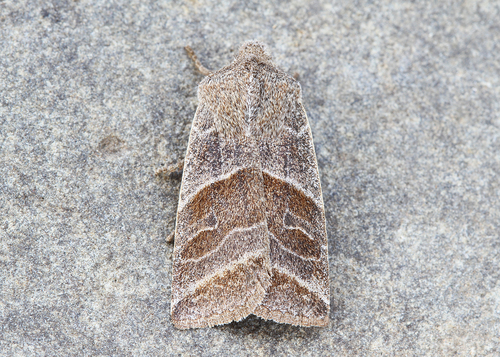
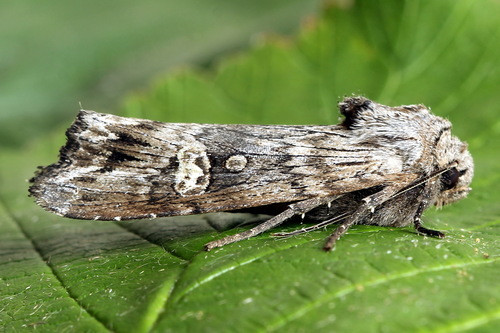
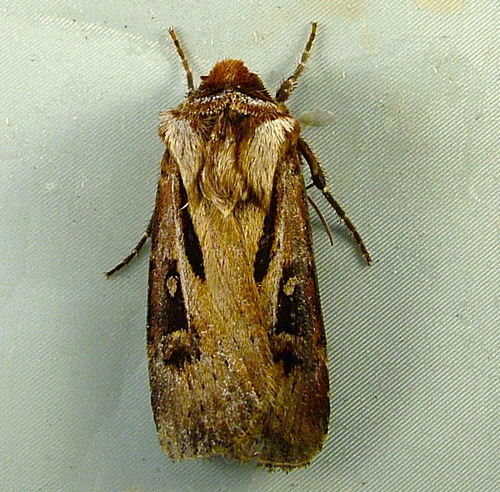
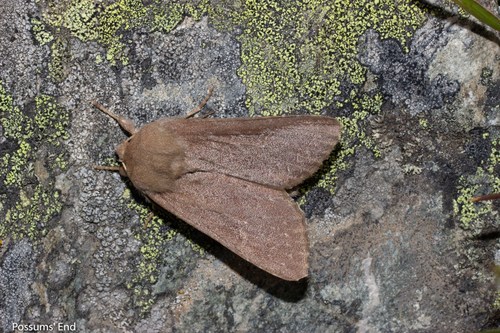
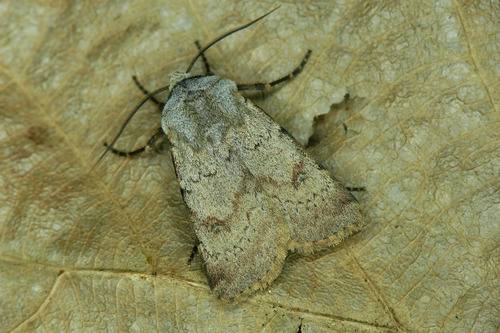
Agrotis cinerea, commonly known as the light feathered rustic, is a moth species belonging to the family Noctuidae. It was first formally described by Michael Denis and Ignaz Schiffermüller in 1775. This species is distributed across southern and central Europe, northern Turkey, the Caucasus, western Turkmenia, and Central Asia. It has a wingspan ranging from 33 to 40 mm. Its forewings are ashy grey with darker sprinkling (called irroration); the claviform and orbicular stigmata are not visible, the reniform stigma appears as a small dark lunule, and a distinct diffuse dark median shade is present. Hindwings are whitish, with a grey tinge in females. Several aberrations and subspecies are recognized. In the aberration alpigena Tur., wings are paler and markings are indistinct, while aberration livonica Teich has much darker wings. Aberration fusca Bsd. is larger than the typical form and colored black brown. The subspecies tephrina Stgr. is smaller, has narrower forewings, and much clearer markings; this subspecies is only found in southern England. In 1892, Tutt writing in Brit. Noct. 11, page 76 worked only with British specimens, and did not recognize that the British race was distinct from continental forms. As a result, the aberrations Tutt described apply solely to the British race. These British aberrations are: ab. pallida Tutt, a pale grey form with no median shade that occurs only in males; ab. obscura Tutt (preoccupied, not Hbn.), a unicolorous dull brown form that is generally (but not always) found only in females; and ab. virgata Tutt, a pale grey form with a distinct reddish median shade that occurs only in males. Adult moths are on wing from May to June, with timing varying by location. They are active both day and night, and can be found near flowers including Berberis vulgaris. The yellowish-white egg has an indistinctly ribbed surface. Fully grown caterpillars are most often earth-grey, helping them blend into their surroundings. They have faint dark lines and stripes along the dorsum and sides, with prominent small black pointed warts. The reddish-brown pupa has a comb-like cremaster equipped with two short thorns. Larvae feed on the roots and leaves of low-growing herbaceous plants and grasses, including Thymus praecox, Stellaria media, Medicago sativa, Rumex, and Taraxacum.