About Agrostis stolonifera L.
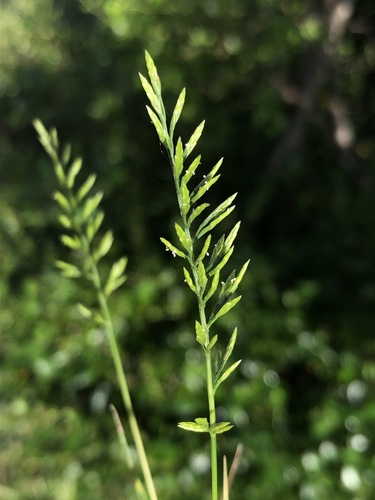
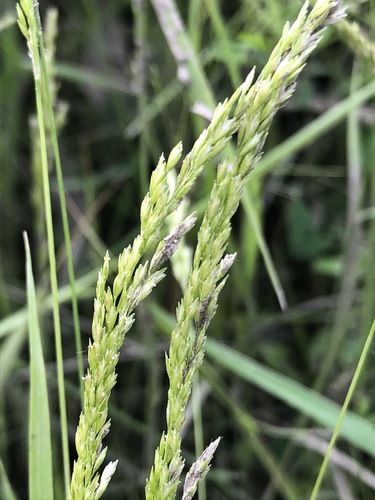
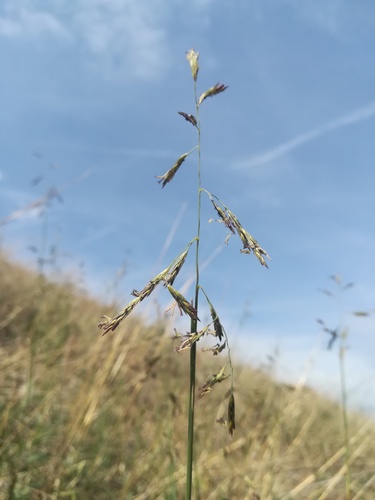
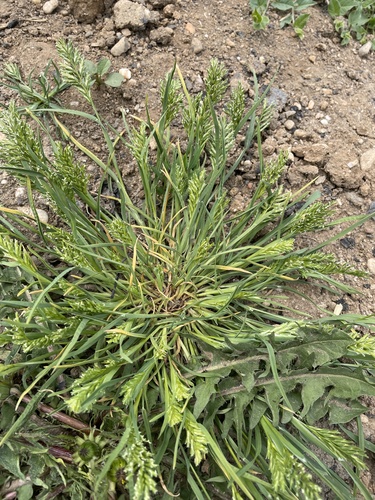
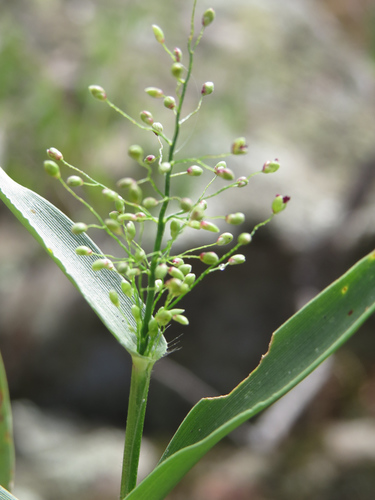
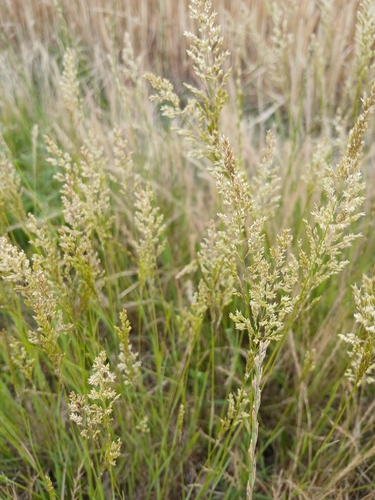
Agrostis stolonifera L. is a stoloniferous grass that can form mats or tufts. Its prostrate stems grow 0.4–1.0 metres (1 ft 4 in – 3 ft 3 in) long, with leaf blades 2–10 centimetres (0.79–3.94 in) long, and a panicle that reaches up to 40 cm (16 in) in height. The ligule is pointed and up to 5 millimetres (0.20 in) long; this distinguishes it from common bent (Agrostis capillaris), which has a short, non-pointed ligule. Its leaves taper towards the tip and often have a blue-grey colour. The grass is not tightly tufted, and its spikelets are red and tightly closed within the panicle.
Where the ranges of species overlap, A. stolonifera is easily confused with the other stoloniferous species A. gigantea and A. castellana. It can be told apart from these two species by its thinner panicle: A. stolonifera's panicle is 0.5-2.5 cm wide, compared to 4-8 cm wide for A. gigantea and A. castellana. In New Zealand, A. stolonifera is suspected to hybridise with A. castellana, which makes identification more difficult.
A. stolonifera and Polypogon monspesulensis are the parents of the sterile intergeneric hybrid ×Agropogon lutosus. ×Agropogon differs from A. stolonifera by having awned lemmas. Compared to P. monspesulensis, ×Agropogon has more persistent spikelets, and lemmas with subterminal awns.
A. stolonifera is native to Eurasia and North Africa, specifically Algeria, Morocco and Tunisia. It may also be native to northern parts of North America; regardless of its original native range there, it has been widely introduced and naturalised across the North American continent and in many other regions. In New Zealand, A. stolonifera became naturalised in 1878, and is widespread across both main islands, as well as the Chatham Islands, Auckland Islands, and Campbell Island. As a weed of wetland areas, it competes with Lachnagrostis tenuis (classified as Threatened - Nationally Vulnerable) and Amphibromus fluitans (classified as At Risk - Declining).
This species grows in a wide variety of habitats, including woodlands, grasslands and meadows, wetlands, riparian zones, and as a pioneer species on disturbed sites. In New Zealand, A. stolonifera is classified as a Facultative Wetland plant, meaning it is usually associated with wetlands and aquatic habitats. It can grow at elevations up to 760 m (2,500 feet).
A. stolonifera is the most commonly used species in the genus Agrostis. It is grown for turf in gardens and landscapes, particularly for use on golf courses. Many putting greens, and an increasing number of fairways, in the northern United States are planted with this creeping bentgrass.