About Agrodiaetus damon (Denis & Schiffermüller), 1776
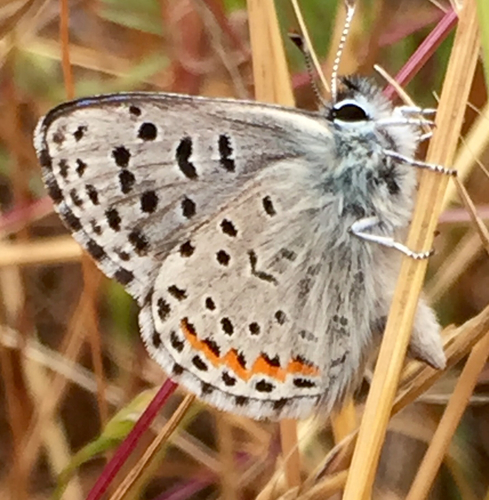
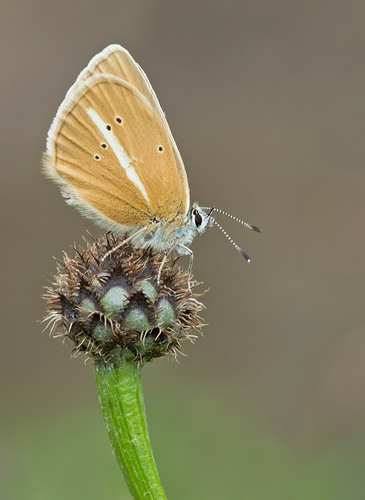
This species has scientific name Agrodiaetus damon (Denis & Schiffermüller), 1776, and is also referred to as Polyommatus damon or the Damon blue. Polyommatus damon has a wingspan of 20–34 mm. These small butterflies exhibit sexual dimorphism. Males have shining blue uppersides of the wings, with broad black borders and prominent veins. Females have brown uppersides of the wings. The underside of the wings is ocher or pale grey-brown, with a series of brown-black spots surrounded by white. In both sexes, hindwings have a white streak, and all individuals also have a white fringe. In Seitz's description, L. damon Schiff. (= biton Sulz.) (81 h): males are large, brilliant shy-blue with a greenish tint, have a broadly black margin, and bright brown undersides that may or may not have ocelli, but always have a sharply marked white mesial streak. Females are dark brown, and sometimes have no traces of reddish submarginal spots on their upperside. This form ranges from Central and South Europe, through Anterior and Central Asia as far as the Tian-shan. Several aberrations are noted. Specimens entirely without ocelli on the hindwing underside are ab. gillmeri Krod. (= caeca Aign.). Individuals with ocelli distorted into oval spots or streaks, produced by Krodel through exposure to low temperature, are ab. extensa Krod. In ab. agraphomaena Verity, the white streak on the underside is not well developed. ab. ferreti Farre is a dwarfed form of the male with a narrow border on the wing upperside. The larva is greenish yellow, finely and densely hairy, with alternating paler and darker green stripes, a brownish head, and a side-line that is darker or paler yellow. It develops until June on Onobrychis (Esparset). Ants are strongly attracted to these larvae: having just a few larvae in an indoor breeding cage is enough to draw whole crowds of ants into the house, which gather around the cages, with as many as ten ants sometimes found on a single larva. The pupa is ochreous, greenish on the upper side, and darker along the back. Adult butterflies are active in July and August in fields of Sainfoin, and do not travel far from these fields. They are abundant in areas where they are found. The distribution and habitat of the Damon blue: this butterfly occurs in Central and Southern Europe, including central Spain, the Pyrenees, the Alps, the Balkans and the Carpathians, and ranges across the Palearctic to Siberia, Mongolia and the Altai Mountains. This mountain species lives in dry bushy or open woodlands, and open grassy areas, at elevations between 990 and 2,100 metres (3,250–6,890 ft) above sea level.