About Agrodiaetus admetus (Esper, 1783)
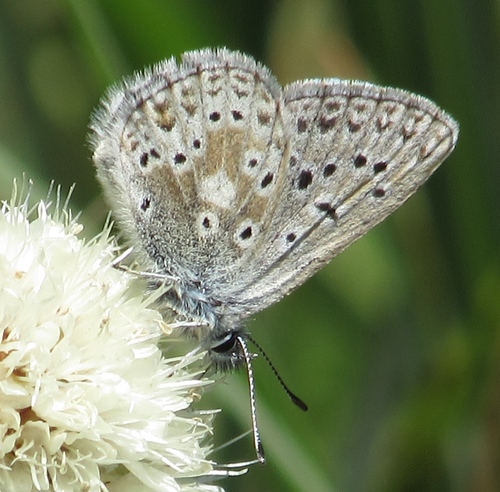
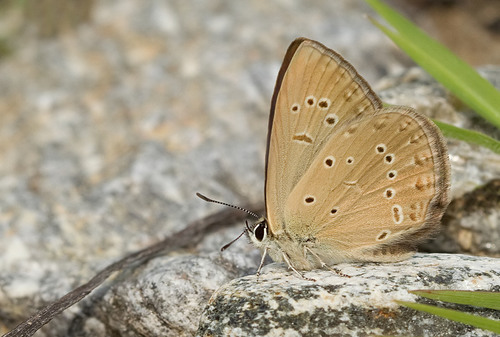
This description of Agrodiaetus admetus (originally referenced as L. admetus Esp.) is taken from Seitz (plate 81 e). Males and females of the nominal species have dull dark brown upper wing surfaces, with no metallic blue or coppery sheen. The discocellular spot on the forewing and black veins are mostly distinctly contrasting. The hindwing, especially that of females, often has faint obsolete reddish anal spots. The underside of the wings is somewhat paler brown than the upper surface; it has distinct ocelli, but no basal ocelli on the forewing. The nominal species is found in South-East Europe, ranging from Hungary and Galicia through the Balkan Peninsula and Asia Minor to Mesopotamia, and it also occurs in Spain. The subspecies or form ripartii Frr. (shown at 81 f) has a white middle streak on the underside of the hindwing that extends from the base to the outer margin. It has a wider distribution than the nominal admetus, and is found in the Alps, South France, Eastern Europe, Asia Minor, Persia, and Turkestan. The egg of this butterfly is greenish when first laid, and turns white as it develops. The larva feeds on Onobrychis cristagalli. Adult butterflies are active in June and July. They fly on slopes with sparse vegetation, and settle particularly on lavender. They are abundant in most of their occupied habitats.