About Agrocybe praecox (Pers.) Fayod
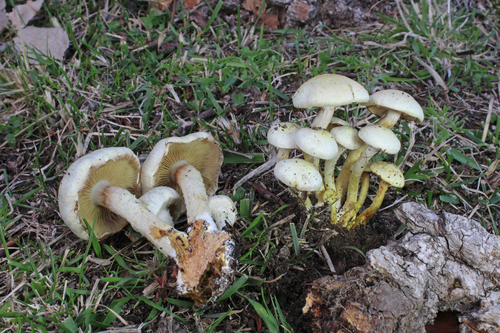
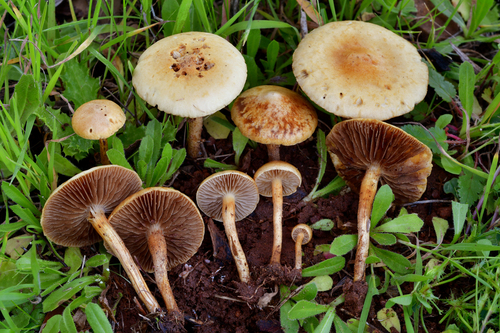
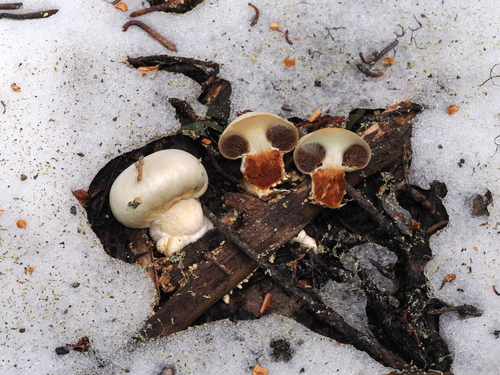
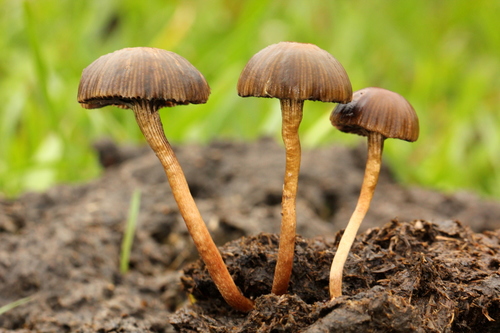
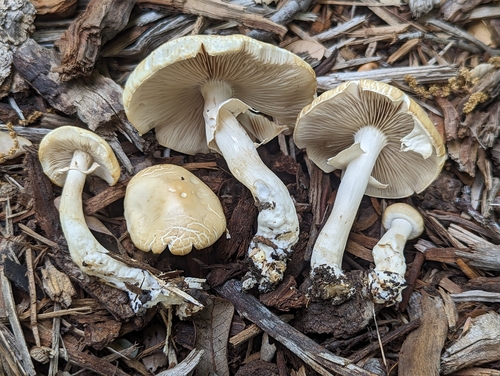
Agrocybe praecox (Pers.) Fayod is part of a group of species that cannot be consistently distinguished from one another easily. Its cap grows up to 10 centimeters (4 inches) wide; it starts bun-shaped and brownish, then becomes convex and lightens to tannish, appearing beige when dry and yellowish-brown when moist, with a smooth texture. Veil remnants can often be seen around the cap rim. The gills are pale grayish when young, and turn brown as the mushroom matures. The stem is pale, measuring 4 to 12 cm (1+1⁄2 to 4+3⁄4 in) long and up to around 2 cm thick, and bears a fragile ring. The stem base often has white mycelial cords. Both the odor and taste of the mushroom are floury, and the taste may also be bitter. The spores are elliptical, measure 8–10 x 5–7 μm, and are brown when massed together. As a saprophyte, like other members of the genus Agrocybe, it grows either alone or in groups in grass, compost, or on wood debris in woodland areas and gardens. It has a widespread distribution across North America (where it fruits from spring to summer), Europe, Asia, and North Africa. It has also been reported to occur in Mongolia, Siberia, Sri Lanka, South Korea, Japan, New Zealand, Argentina and Colombia. This species does not have a strong flavor, and is sometimes considered edible. However, because it is part of a hard-to-distinguish species group, it can be confused with inedible related species. One French source notes that its bitterness and soft texture mean it is best avoided. One source states it is edible if cooked thoroughly. Author Roger Phillips lists Agrocybe praecox as inedible.