About Agrocybe pediades (Fr.) Fayod
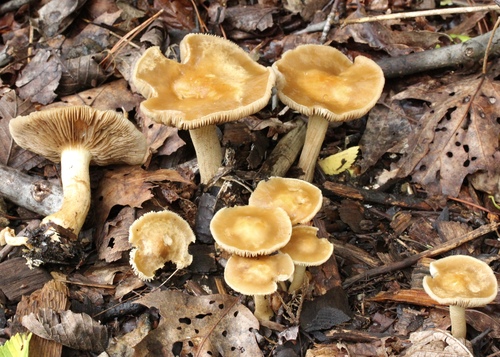
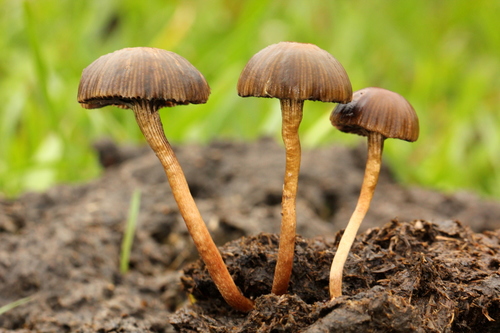
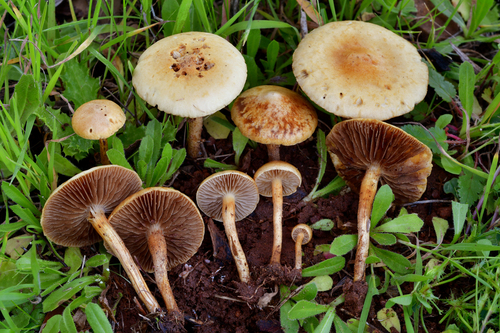
Agrocybe pediades has a mushroom cap that is 1–3 cm wide, starting round to convex and flattening as it ages. The cap ranges in color from pale yellow to orangish-brown, has a smooth texture that sometimes cracks, and is tacky when moist, otherwise dry. Its stalks measure 2–7 cm long and 1–4 mm wide. A partial veil disappears quickly, leaving only faint traces on the cap edge, with no persistent ring left on the stem. Both the odor and taste of the cap are mild or mealy. The spores are brown, elliptical, and smooth, and produce a brown spore print. Some taxonomic experts divide A. pediades into several separate species, distinguished mainly by habitat and microscopic characteristics such as spore size. This species is identified by its large, slightly compressed basidiospores that have a large central germ pore, 4-spored basidia, subcapitate cheilocystidia, and rarely, the development of pleurocystidia. Agrocybe pediades is most commonly found growing on lawns and other types of grassland, but it can also grow on mulch that contains horse manure. In North America, it can appear year-round. This species is classified as edible, but it can be easily confused with poisonous species, including members of the genus Hebeloma and various other small brown mushrooms. Many field guides list this species as inedible, or note that it is not worth collecting for eating.