About Agrochola lychnidis (Denis & Schiffermüller), 1775
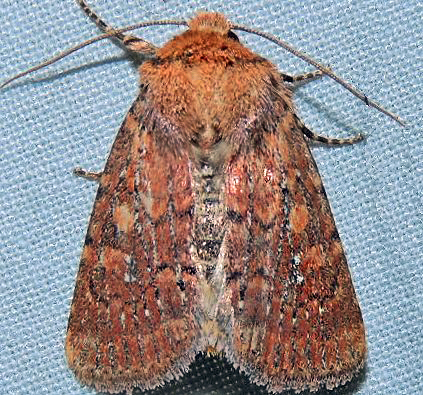
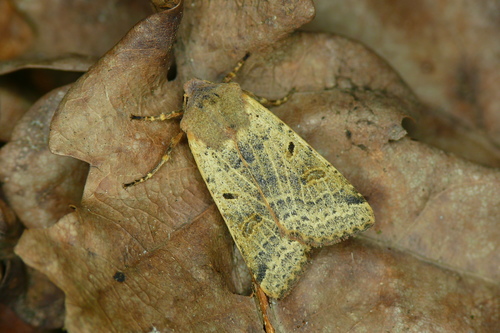
Agrochola lychnidis, commonly known as the beaded chestnut, is a species of moth in the family Noctuidae. It was first described by Michael Denis and Ignaz Schiffermüller in 1775. Its distribution covers all of Europe, extending from Ireland to the Urals. It is also found in western North Africa and Asia Minor. The wingspan of this moth is 30–35 mm. The forewing is bright rufous (reddish) or reddish ochreous, with paler veins, and is often dusted with darker pigment. The inner and outer lines are double, dark, with a rufous center; they are often very faint, but always marked by black spots on the costa. The submarginal line is preceded by a row of dark lunules between the veins and a dark bar at the costa. The median shade is distinct. The stigmata are blackish and distinct, this is most noticeable for the narrow oblique orbicular stigma. The hindwing is dark grey, with a rufous fringe. This species varies extremely in color. Brighter rufous specimens with pale veins represent the typical lychnidis F. form. Duller brownish forms that also have pale veins are classified as pistacina F. The rubetra Esper form is a bright rufous unicolorous form with all markings indistinct, and the costal edge is often conspicuously white at the middle; ferrea Haw. is an offshoot of this form that only has the four costal blotches and the stigmata dark. The paler, reddish ochreous, unicolorous form is obsoleta Tutt. Among forms without red coloring, serina Esp. has clear markings, while in pallida Tutt the markings are obscure, and the ground colour is greyish ochreous or yellowish. Among brownish rufous or brownish grey forms, brunnea Tutt is a more sombre form than pistacina and lacks pale nervures. The canaria Esp. form has dull fulvous lines, veins, and edges of the stigmata, and a blackish ground colour; as a rule, males of this form are much darker than females. Similar dark specimens also occur that only have dull brown light shades and less black dark interspaces. The caerulescens Calb. form, found in Italy, is a bluish or lilac grey moth; this form also occurs in Asia Minor. A large number of specimens from Amasia, especially females, match this form exactly, while the remaining specimens, mostly males, become greyish luteous as in serina, with markings varying in intensity. When first laid, the egg is yellowish, but changes to olive-brown as it develops. The larva is green tending towards yellowish, freckled with greyish, and dotted with whitish. It has three fine whitish lines along the dorsum, and a broad white lateral stripe.