About Agrochola lota Clerck, 1759
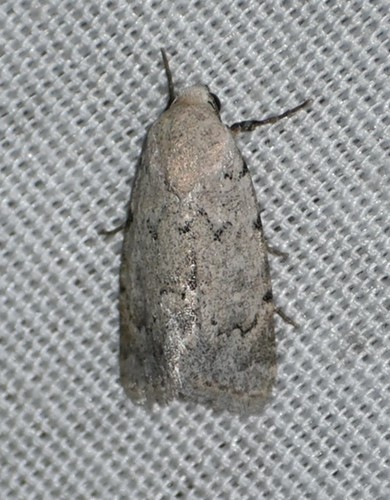
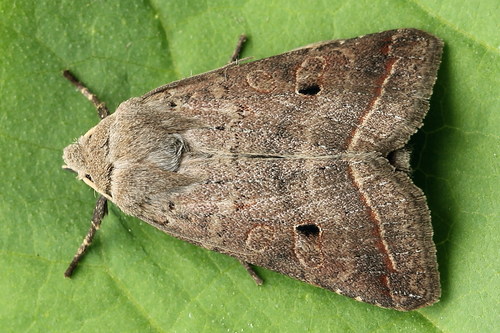
The forewings of Agrochola lota are grey-brown or leaden grey, often with a reddish tinge. Its inner and outer lines are double, conversely lunulate-dentate, but are rarely visible; a thick dark median shade is present. The stigmata are grey, with pinkish annuli edged with rufous, and the lower half of the reniform stigma is black. The submarginal line is nearly straight but angled on vein 7, and is pale with rufous inward edging. The hindwings are dark grey, with a darker cell spot and darker submarginal cloud. Reddish individuals where all grey tones are replaced by rufous make up the aberration rufa Tutt. In rare cases, the grey darkens to black; this is aberration suffusa Tutt from Ireland. Another equally rare form from England, where the ground color is whitish grey, is pallida Tutt. In a form from Amasia, aberration subdita ab. nov. [Warren], the grey ground color of both wings is duller and paler, and the black marking in the lower lobe of the reniform stigma is much reduced. The spherical egg of Agrochola lota is initially yellowish white, and turns dark reddish-brown before hatching. It is covered with strongly curled longitudinal ribs. Young larvae are bluish grey; fully grown larvae are grey to grey-brown and finely marked with black. The underside is whitish grey to ochre. The dorsal and dorsolateral lines are white and partly slightly interrupted, and the numerous small white point warts are outlined in black. The pupa has four curved thorns on its wide, short cremaster. Agrochola plumbea (Wiltshire, 1941), the Asian sister species of Agrochola lota, can only be distinguished from A. lota through genital morphological examination. Agrochola lota occurs mainly in humid habitats, including shores, floodplains, clearings, bogs, and wet meadows. The adult moth flies from September to October and is attracted to light. Young caterpillars feed on the catkins of sallow and willow (Salix), and switch to feeding on leaves when they reach maturity. By day, caterpillars hide within spun leaves, and feed at night.