About Agriphila inquinatella (Denis & Schiffermüller), 1775
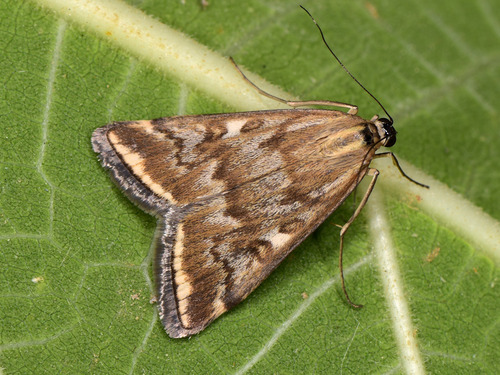
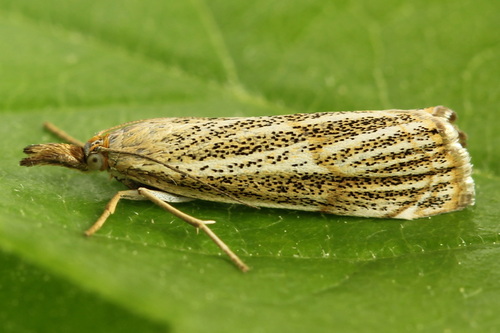
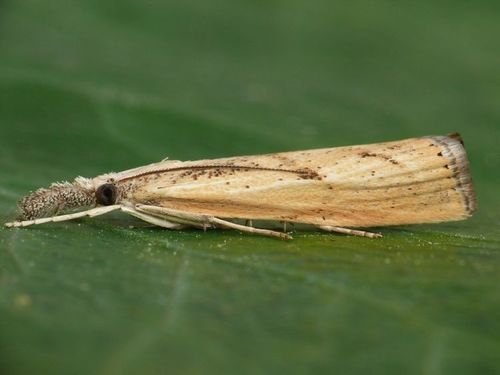
The scientific name Agriphila inquinatella has been misapplied to several related species in the past; more details on this are covered below. Agriphila inquinatella is a small moth species belonging to the family Crambidae. This species is distributed across Europe, from the Caucasus region to Turkestan, and from the Near East to Jordan. Its type locality is located in Austria. Three subspecies of Agriphila inquinatella are currently accepted: Agriphila inquinatella inquinatella (Denis & Schiffermüller, 1775), which occurs across most of the species’ total range; Agriphila inquinatella nevadensis (Caradja, 1910), found in the Sierra Nevada and presumably in other parts of Spain; and Agriphila inquinatella elbursella (Zerny, 1939), found in the Alborz mountains and presumably in other parts of the Caucasus region. The wingspan of this moth measures 23 to 29 mm. It is similar in appearance to Agriphila geniculea and Agriphila tolli. The ground color of its forewings ranges from cream to straw brown. The forewings are covered in scattered black scales, and their veins are broadly marked in whitish. There is a distinctive dark stain on the dorsal side of the discal cell, which also sits on the upper edge of the angled median streak. The outer cross-line is broken by projections of the median streak, and there is a single row of black sub-terminal dots. The cilia are grey. In the closely similar A. geniculea, the lines are strongly angled and the cilia are glossy or metallic. According to Meyrick’s description: The face bears a sharp cone. Forewings are light yellow-ochreous, somewhat mixed with pale brownish, and have scattered dark fuscous scales; sometimes the forewings are more or less entirely suffused with rather dark brown. The veins are suffusedly paler or whitish-ochreous, especially the median vein. The angled median and second lines are indistinct and brownish, marked with dark fuscous below the middle. There is a terminal series of black dots, and the cilia are rather dark shining fuscous, and paler in females. Hindwings are grey. Fully grown larvae are dull grey-greenish to purplish-brown, with large, darker spots and a dark brown or blackish head. The caterpillars of this species feed mainly on Poaceae grasses, such as meadow-grass species (Poa) or sheep's fescue (Festuca ovina), feeding inside silken galleries. They can be found under pebbles next to their food plants, which suggests they feed on the plants' roots. One less common recorded food plant is the Pottiales moss Tortula muralis.