About Agriornis montanus (Orbigny & Lafresnaye, 1837)
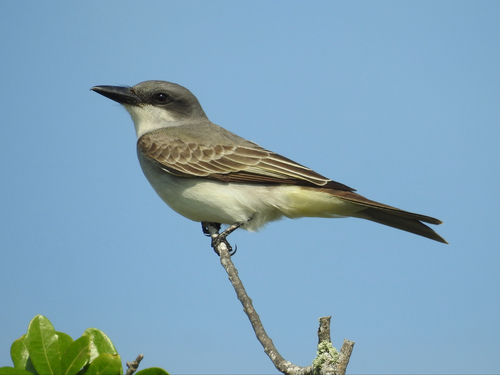
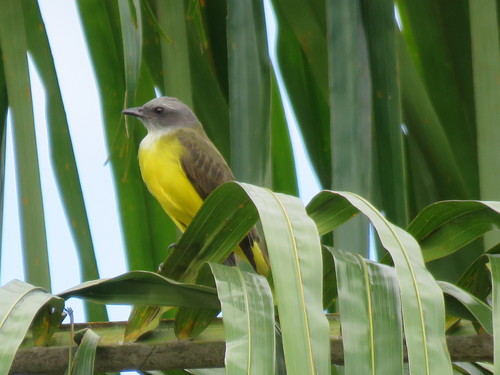
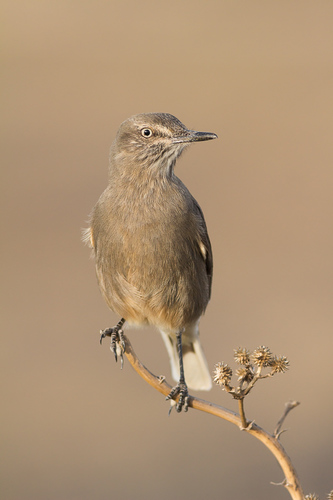
The black-billed shrike-tyrant (scientific name Agriornis montanus, first described by Orbigny & Lafresnaye in 1837) is 22 to 24 cm (8.7 to 9.4 in) long, and males and females share identical plumage. Adults of the nominate subspecies A. m. montanus have a whitish stripe above the lores, a buffish white broken supercilium, and brown-streaked white cheeks. Their crown and upperparts are dark grayish brown. Their wings are mostly dark grayish brown, with whitish tips and edges on the inner flight feathers, and their underwing coverts range from cinnamon-buff to buffy white. Their central pair of tail feathers is blackish; the rest are white with dark bases on their inner webs. Their throat is white with thin blackish streaks, their breast and flanks ashy brown, their mid-belly whitish-tinged brown, and their lower belly and vent whitish. Other subspecies differ from the nominate and each other in the following ways: A. m. solitarius is darker than the nominate and has entirely white outer tail feathers; A. m. insolens is darker than the nominate but lighter than solitarius, with mostly white outer tail feathers that sometimes have dusky edges on the inner webs of some feathers; A. m. maritimus has black central tail feathers with white tips, and its outer tail feathers have more black at the base than the nominate; A. m. intermedius is similar to maritimus but has much less black on its outer tail feathers; A. m. fumosus has dark gray upperparts, brownish gray breast, light cinnamon brown upper belly, brownish gray flight feathers with dark brown tips, dark brown central tail feathers with whitish tips, and the remaining tail feathers have dark bases and creamy white ends. Adults of all subspecies have a yellowish to ivory iris, a hooked black bill, and blackish legs and feet. Subspecies of the black-billed shrike-tyrant have the following distribution across South America: A. m. solitarius is found in the Andes from Nariño Department in southwestern Colombia south through Ecuador; A. m. insolens is found in the Andes of Peru; A. m. intermedius is found in the Andes from La Paz Department in western Bolivia south into far northern Chile's Tarapacá Region; A. m. montanus is found in the Andes from southern Beni Department in Bolivia south into northwestern Argentina as far as La Rioja Province; A. m. maritimus is found in the Andes of central and southern Chile from Tarapacá south to Magallanes Region, and in west-central and southwestern Argentina from Mendoza Province south to Santa Cruz Province; A. m. fumosus is found in the Sierras de Córdoba in central Argentina. An isolated population that is either A. m. maritimus or A. m. fumosus occurs in Argentina's Buenos Aires Province. The South American Classification Committee of the American Ornithological Society has unconfirmed records of the species from the Falkland Islands, and classifies the species as hypothetical there. The black-billed shrike-tyrant lives in a wide variety of open, generally high-elevation landscapes, ranging from the upper temperate zone into the páramo. These habitats include grasslands and agricultural areas with scattered bushes and trees, the edges of Polylepis forest, Puna grassland with perches such as fences and boulders, rocky slopes and cliffs, villages, and isolated buildings. Its elevation range varies by region: between 2,500 and 3,700 m (8,200 and 12,100 ft) in Colombia; mostly between 3,000 and 4,000 m (9,800 and 13,100 ft) in Ecuador, going as low as 2,500 m (8,200 ft) in southern Ecuador; between 3,000 and 4,500 m (9,800 and 14,800 ft) in Peru, and locally as low as 2,200 m (7,200 ft); in Chile and Argentina, it mostly occurs between 3,000 and 4,000 m (9,800 and 13,100 ft), and rarely goes down to sea level in Chile.