About Agriornis micropterus Gould, 1839
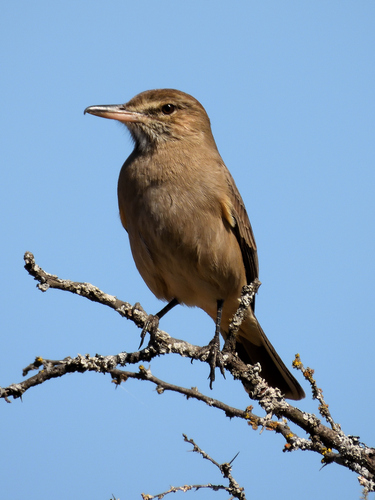
The grey-bellied shrike-tyrant, formally Agriornis micropterus Gould, 1839, measures 23 to 24.5 cm (9.1 to 9.6 in) in length. Adult males of the nominate subspecies have a gray-brown crown, a whitish supercilium, rufous-tinged ear coverts, and black and white streaked cheeks. Their upperparts are gray-brown. Their wings are mostly gray-brown with whitish edges on the secondaries and pale grayish coverts. Their tail is mostly black, with narrow white edges on the outer webs of the outer feathers. Their throat is white with heavy black streaks, their breast is pale brown, their flanks are washed with a buffy shade, and their belly ranges from pale gray-brown to whitish. Adult females are otherwise identical to males, differing only by having dark brown streaks on their throat. Juveniles are browner on the upperparts than adults, with pale cinnamon-brown underparts and very few streaks on the throat. The subspecies A. m. andecola is larger and slightly darker than the nominate subspecies, with a tawny tinge to the vent area. Adult individuals of both sexes across both subspecies have a dark iris, a straight hooked bill with a dark brown maxilla and an orange mandible, and dusky legs and feet. There are two recognized subspecies of the grey-bellied shrike-tyrant, and A. m. andecola is the more northerly one. It occurs from Puno Department in southern Peru south through western Bolivia, into the eastern portion of northern Chile's Tarapacá Region, and into northwestern Argentina as far south as Catamarca and Tucumán provinces. Multiple taxonomic and ornithological sources disagree on the range of the nominate subspecies. According to BirdLife International (BLI) and the Cornell Lab of Ornithology's Birds of the World, the nominate subspecies is found from southern Bolivia south through western Paraguay and southern Uruguay into Argentina, reaching as far south as central Santa Cruz Province. However, the map included in Peña's Birds of Southern South America and Antarctica does not include Uruguay within the species' range. The South American Classification Committee of the American Ornithological Society only lists the species as a vagrant in Uruguay, and Cornell notes that there are no recent confirmed records of the species in Uruguay. The SACC also has a record of the species as a vagrant in Brazil, which Cornell also acknowledges. The Clements taxonomy includes Uruguay in the nominate subspecies' range, but does not include Bolivia. The grey-bellied shrike-tyrant primarily inhabits steppe and puna grassland that contains shrubs and boulders. During the austral winter, it can also be found in agricultural fields. Across its full range, it occurs at elevations from sea level up to 5,000 m (16,000 ft); within Peru specifically, it is found between 3,800 and 4,100 m (12,500 and 13,500 ft) in elevation.