About Agriornis lividus (Kittlitz, 1835)
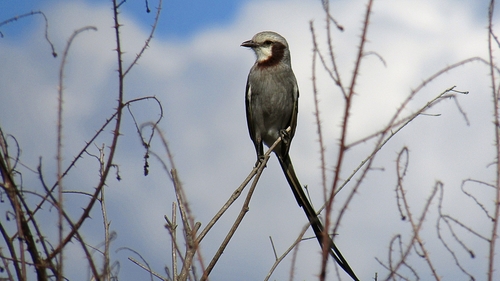
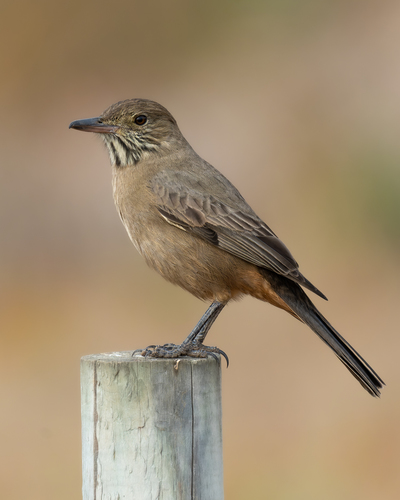
The great shrike-tyrant (Agriornis lividus) is the largest species of tyrant flycatcher. Adults average about 99 g (3.5 oz) in weight, and measure 26 to 28 cm (10 to 11 in) in length. Both sexes have identical plumage. For the nominate subspecies, adults have a mostly grayish brown head, with whitish coloring on the lores and a cinnamon tinge on the ear coverts. Their upperparts are grayish brown, their wings are mostly a darker duskier grayish brown with pale brown edges along the flight feathers. Their tail is mostly black, with buffy white tips and edges on the outer webs of the outer tail feathers. Their throat is white with heavy black streaks. Their underparts are a paler grayish brown than their upperparts, with a cinnamon or cinnamon-buff wash on the lower belly and crissum. Subspecies A. l. fortis is larger and slightly brighter in color than the nominate subspecies. Juveniles are browner overall than adults, with indistinct streaks on the head, back, and upper breast, less streaking on the throat than adults, and a fully cinnamon-buff belly. Adults of both subspecies have a dark iris, a heavy hooked bill with a black maxilla and a dark-tipped orange mandible, and blackish legs and feet. The nominate subspecies is distributed along the coast and mountains of Chile, from the Atacama Region to Valdivia in the Los Ríos Region. Subspecies A. l. fortis is found in far southern Chile's Aysén and Magallanes regions, and in southern Argentina from southern Neuquén Province south into Tierra del Fuego. This species lives in semi-arid to moderately moist landscapes. Habitats it uses include scrublands with cacti and bromeliads, moderately open shrubby areas, agricultural regions, pastures adjacent to shrubby areas, and open Nothofagus woodlands. It avoids dense heavily wooded areas and populated human settlements. In terms of elevation, it occurs from sea level up to 1,800 m (5,900 ft), though most individuals are found below 1,500 m (4,900 ft).