About Agriopis aurantiaria (Hübner)
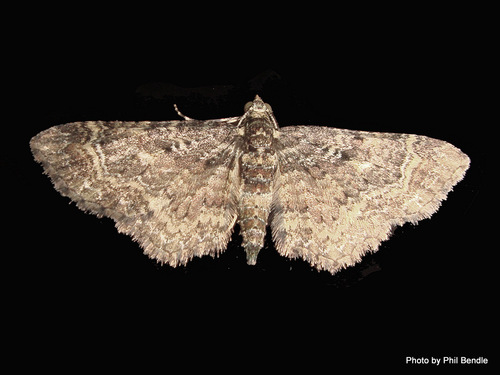
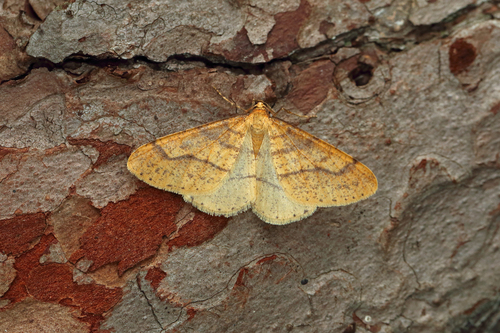
Agriopis aurantiaria, commonly known as the scarce umber, is a moth species in the family Geometridae. It was first described by Jacob Hübner in 1799. This moth is distributed across Europe, ranging from Spain through Central Europe to Russia; in the south, its range extends from the western Mediterranean to the Black Sea and the Caucasus, while its northern limit reaches central Fennoscandia. It can occupy a wide variety of habitats, including deciduous forests, orchards, gardens, parks, and settlement areas. The species has a wingspan of 27–35 mm, and exhibits strong sexual dimorphism. Males have fully developed wings. Their forewings range from dark golden yellow or orange yellow to light brown, are covered in numerous black scales, and feature three brown-grey transverse bands, with the outermost band broken. Large black patches may sometimes appear in the postdiscal area. Hindwings share the same base colour as forewings, but are always paler and marked with two thin dark lines. Males have double saw-combed antennae, and can be distinguished from related species by their bright golden-brown colour. Two recorded forms exist: ab. fumipennaria Heilweger has infuscated violet-brown forewings with only yellow fringes, and hindwings that are more or less smoky; male ab. fasciata Linstoiv has a dark band located distally to the postmedian line. Flightless females have almost entirely vestigial wings, a clumsy body shape that tapers at the end, and are grey-brown in colour. Their stub wings are grey with two black cross markings. Eggs are flattened at one end, longitudinally ribbed, and purplish. Caterpillars are yellowish with an ochreous tinge, have brown lines along the back, and purplish stripes on the sides. The underside is dark purplish brown, approaching blackish, and striped with yellowish. Adults are active and in flight from October to November. Larvae feed on a variety of deciduous tree species, including Betula, Quercus robur, Sorbus aucuparia, Rosa, and Prunus padus.