About Agrimonia procera Wallr.
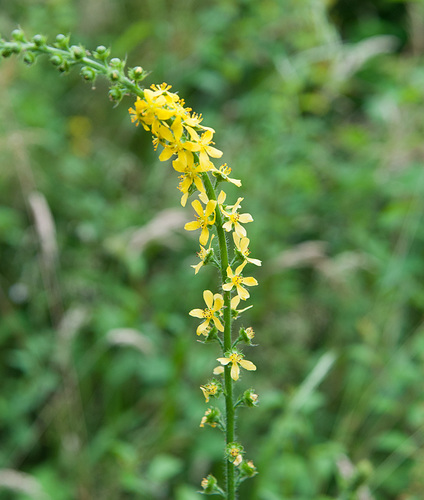
Agrimonia procera Wallr., commonly called fragrant agrimony, is a herbaceous perennial plant that grows to about 1 meter tall. It has a green stem that may be branched or unbranched, covered in glandular hairs 2 mm long or slightly longer. Its leaves are pinnate, with 3 to 6 pairs of oval, distinctly serrated primary leaflets, an irregular number of smaller secondary leaflets, and a terminal leaflet that is similar in size or slightly larger than the primary leaflets. The underside of the leaves is covered with shiny yellow glands that produce a sweet aroma. Flowers grow in long racemes at the top of the stems; each flower has 5 yellow petals, 5 to 20 stamens, and 2 carpels. The hypanthium develops into a characteristic brown, oval or bell-shaped fruit with deep lateral grooves and a double ring of hooked bristles around its center, which holds 1 or 2 achenes.
Fragrant agrimony is easily confused with common agrimony, which shares a similar distribution and habitat. Key distinguishing features include that fragrant agrimony has longer stem hairs (with no short hairs), more deeply and acutely serrated leaves with more glands on the underside, and fruits with shorter grooves and reflexed bristles. When comparing the two species side-by-side is not possible, the direction of the hooked bristles is the most reliable identifying feature. If the bristles are considered to emerge from the fruit's "equator", most bristles point "southwards" or at most straight out in common agrimony, while in fragrant agrimony some bristles distinctly point "northwards", towards the stalk.
The native distribution of fragrant agrimony is thought to cover almost all of Europe and South Africa, with no native range in the territory between the two regions. This strikingly disjunct distribution is highly unusual, and may be caused by seed transportation by migrating wild birds or a more recent human introduction. In South Africa, the species is generally considered native and officially categorized as "least concern", though some sources such as the citizen science website iNaturalist describe it as invasive there.
In Britain and Ireland, fragrant agrimony grows in woodland margins, scrub, road verges, and tall grassland, on circumneutral (neither acidic nor alkaline), sometimes damp, soils. It is restricted to lowlands, with the highest recorded elevation at 335 m near Fortingall, Perthshire. Compared to common agrimony, it is a larger, bushier, more leafy plant, and far less common, despite having a similar overall range. It is most abundant along rides in oak or sometimes ash woods, or on nearby field edges. It flowers later than common agrimony, typically starting in late July in southern England.
Little research has been done on interactions between fragrant agrimony and other species. The British database of insects and their food plants records only one aphid, Acyrthosiphon malvae (Mosley, 1841), that has been observed growing on this plant. Its hooked seeds are well structured for animal-facilitated dispersal, but it is not known which animal species are primarily involved in dispersal.
Fragrant agrimony is palatable to livestock, and grows in grazed woodland, meadows, and pastures. Like other agrimony species, it has been reported to have beneficial health effects on experimental animals, and to reduce inflammation in in vitro cells. Compounds from the plant currently under investigation include the bitter-tasting compound agrimoniin and various flavonoids. Agrimony is often promoted as having human health benefits, but medical sources emphasize that evidence for its efficacy and safety is generally lacking. Claims about its historical uses may be exaggerated: the influential Roman medical author Celsus only mentions agrimony as a possible cure for snake bites. With its bitter taste, agrimony is commonly used in herbal teas. Most commercial herbal tea blends specify common agrimony rather than fragrant agrimony, but it is not always clear that people have correctly differentiated between the two species.