About Agrimonia eupatoria L.
Common agrimony, scientifically known as Agrimonia eupatoria L., is a deciduous perennial herbaceous plant that reaches heights of up to 100 cm (39 in). It has deep rhizome roots, from which its stems grow. Its defining vegetative feature is the typical serrated-edged pinnate leaves.
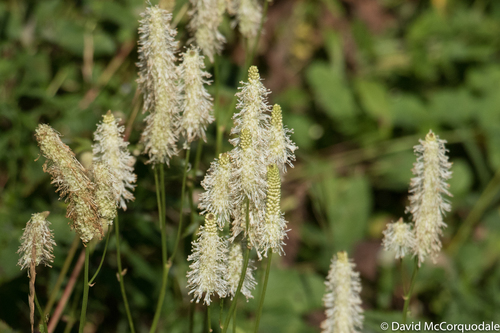
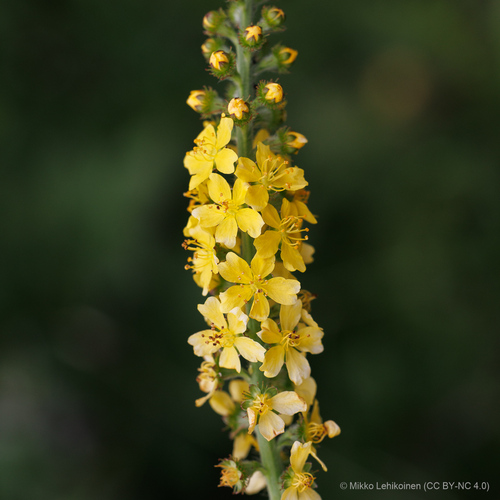
Short-stemmed flowers of common agrimonia bloom from June to September, arranged in long, spike-like racemose inflorescences. Individual flowers have an urn-shaped curved flower cup, with several rows of soft, curved hook-shaped bristles 1–4 mm (0.039–0.157 in) long along the upper edge. Each hermaphrodite flower has fivefold radial symmetry, five sepals, and five yellow rounded petals. Both the petals and the five to 20 stamens extend above the tip of the flower cup. The two medium-sized carpels are sunk inside the flower cup but not fused to it. The fruits are achenes around 0.6 cm (0.2 inch) in diameter, each covered in hooks that let the fruit cling to animal fur and human clothing. Each achene holds one or two seeds.
Agrimonia eupatoria is native to Europe and Southwestern Asia, where it grows in damp meadows, pasture, along stream banks, and among shrubs.
In terms of ecology, the flowers produce abundant pollen that attracts hoverflies, flies, and honey bees. They are also an important food source for butterflies such as the grizzled skipper. After pollination, flowers develop burred fruits that attach to passing grazing animals like cattle, sheep, and deer, which disperse the seeds over large areas. Common agrimony usually grows in young grasslands that are less than 50 years old. It also acts as a wild host for two insect pest species, Stigmella fragariella and Coroebus elatus, that feed on loganberries, raspberries, and strawberries in Europe.