About Agrilus biguttatus (Fabricius, 1776)
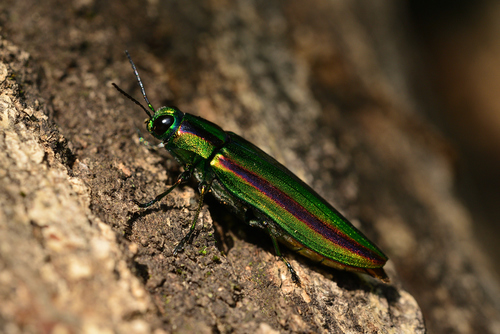
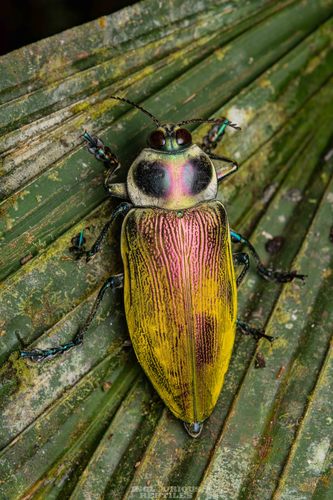
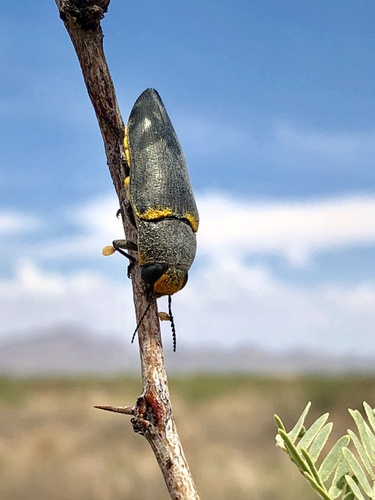
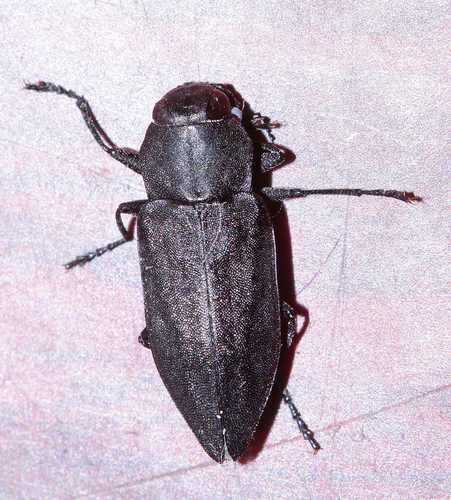
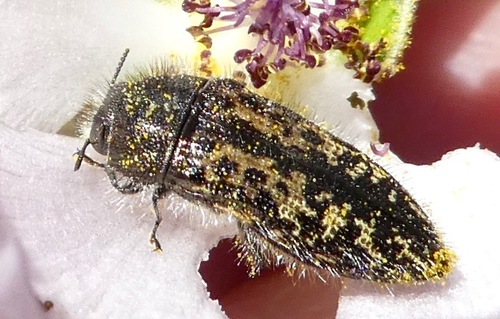
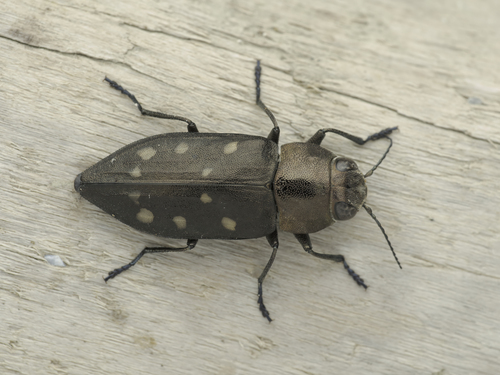
Agrilus biguttatus, first described by Fabricius in 1776, is a species of beetle belonging to Buprestidae, the jewel beetle family. Its common names are oak splendour beetle, oak buprestid beetle, and two-spotted oak borer. This beetle is recognized as a pest that damages oak trees, and it is a major contributor to oak decline. Adult beetles measure 8 to 13 millimeters long. They are metallic green with a black or yellowish tint, and have a pair of white spots on the inner edges of their elytra. Larvae are creamy white, and can reach up to 43 millimeters in length. The first thoracic segment of the larva is enlarged; the legless grub has a pair of horns on its final abdominal segment. The average lifespan of this beetle is 2 months, though some individuals can live over 5 months. Agrilus biguttatus is widespread across Europe, reaching as far north as the southern border of southern Sweden and the UK, and also occurs in North Africa and Northern Asia. While adult beetles can fly several kilometers, cool temperatures limit the species' distribution. Before the 1970s, this beetle was considered rare in the UK. Starting in the mid-1990s, A. biguttatus began expanding out of its native range in Denmark and the Netherlands. Researchers have proposed that this expansion is mostly caused by global warming, since the species prefers more temperate regions. The beetle lives in a wide range of environments, including deserts, xeric shrublands, Mediterranean scrub, mixed forests, and temperate coniferous forests. It can also be carried to new locations via shipments of wood. Although Agrilus biguttatus is not currently present in the United States, its introduction would present a significant risk to US natural environments. The main host plants of this insect are oak species, specifically English oak (Quercus robur), sessile oak (Q. petraea), downy oak (Q. pubescens), evergreen oak (Q. ilex), cork oak (Q. suber), and turkey oak (Q. cerris). The beetle can also be found on European beech (Fagus sylvatica) and sweet chestnut (Castanea sativa). In Europe, A. sulcicollis, A. angustulus, and A. biguttatus are all identified as significant contributors to oak decline due to their development patterns. Unlike related species that prefer to infest trees with smaller stem diameters or develop in branch bark, A. biguttatus larvae typically develop within the bark of the main tree trunk. Because of the damage A. biguttatus causes to oak trees, efforts have been made to manage its population. Common control strategies for this beetle in Britain are outlined as follows: