About Agriades glandon (von Prunner, 1798)
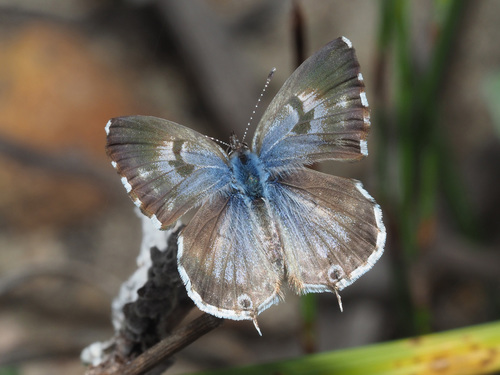
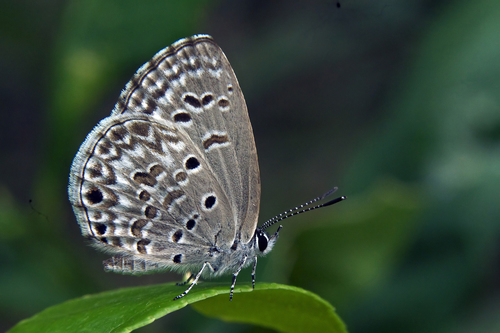
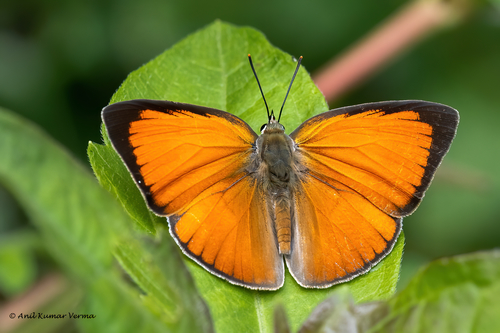
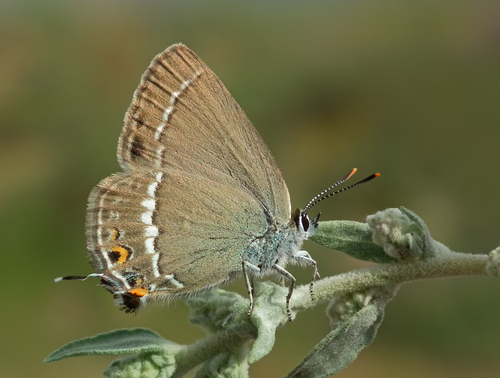
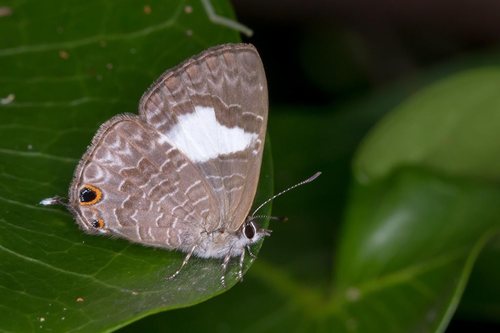
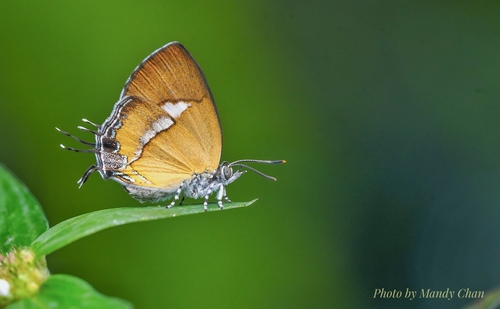
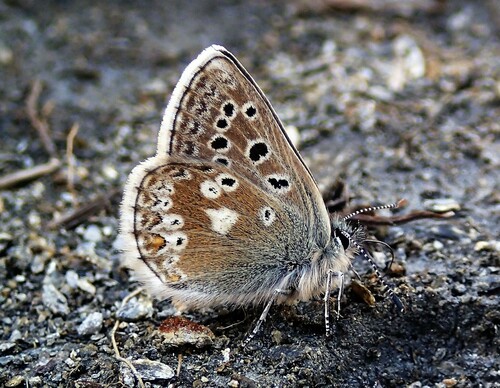
Agriades glandon (von Prunner, 1798) has a wingspan of 17 to 26 mm. On the upperside of the male’s wings, the color is silver, steely blue, or pale shining blue, growing increasingly brown toward the wing edges. On the upperside of the female’s wings, the color is almost entirely brown, with a slight bluish dusting in the basal wing region. Darkening of wing color becomes more common as altitude increases. All wings of this species usually have small dark disk spots, which are sometimes surrounded by white. Both sexes have black dots rimmed with white on the pale grey-brown background of the forewing underside. The hindwing underside has striking white spots on a greyish-brown background, and occasionally also has orange-colored dots. While this species shows large geographic variability in wing pattern, it is clearly distinguishable from other bluish species in a three-species complex with wide geographic separation across Europe. Only two species overlap with it in range in Europe and could be confused for it. In the Alps and Pyrenees, the more localized, less common Aricia nicias has fine underside markings and a white stripe. In the Pyrenees, Agriades pyrenaicus may also occur in the same flight locations. Unlike A. glandon, A. pyrenaicus has bold black rather than faint grey-brown forewing underside submarginal spots, and black markings on the hindwing underside are relatively greatly reduced or absent entirely. Other similar species do not overlap in distribution with A. glandon; these are Agriades zullichi (found in Spain) and Agriades aquilo (found in Arctic Europe), and these two are sometimes treated as subspecies of Agriades glandon. In North America, this species occurs from Alaska east to Newfoundland, extending south through mountains to Washington, northern Arizona, and northern New Mexico. In Europe, it occurs in mountainous areas including the Pyrenees and Alps, as well as in the far north. It is also found in parts of Russia, including Siberia and Kamchatka. Its habitats include arctic tundra, subarctic and subalpine forests, mountain meadows, and bogs. This butterfly flies from mid-May to September, with flight timing varying by location. In the European part of its range, Clarke 2022 lists Astragalus alpinus, Saxifraga aizoides, and Saxifraga oppositifolia as larval food plants for the taxon Agriades aquilo. For Agriades glandon, Clarke records these larval food plants: multiple Androsace species (A. alpina, A. chamaejasme, A. lactea, A. laggeri, A. obtusifolia, A. villosa, and A. vitaliana), Soldanella alpina, Soldanella pusilla, and Oxytropis campestris. Additional recorded larval food plants for Agriades glandon include Androsace bungeana, Androsace septentrionalis, Diapensia lapponica, Vaccinium, and two Saxifraga species: Saxifraga bronchialis and Saxifraga spinulosa.