About Agonis theiformis Schauer
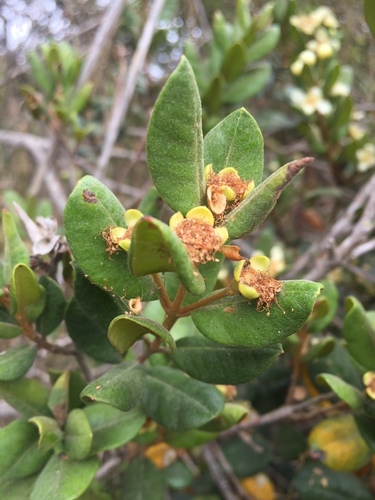
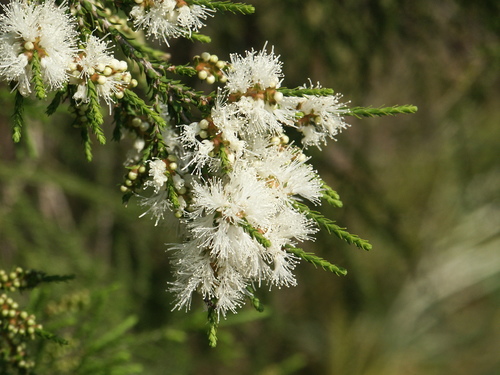
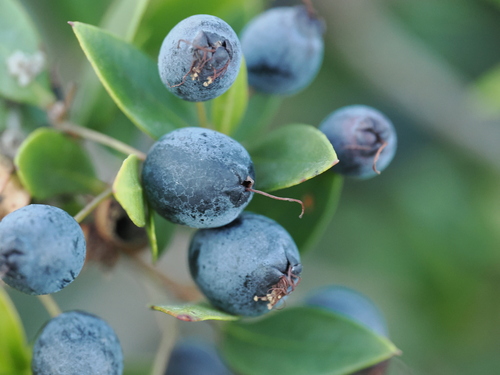
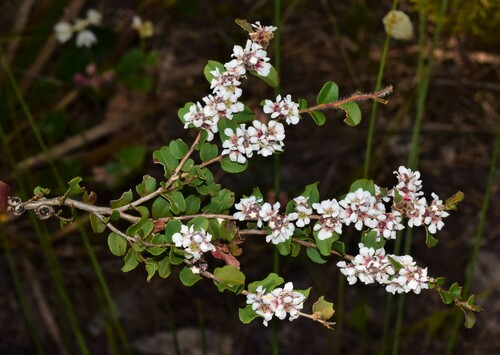
Agonis theiformis is most commonly a spindly shrub, typically growing to a height of 2 to 3 meters (6 feet 7 inches to 9 feet 10 inches). Its branchlets are sometimes zig-zagged, hairy when young, and become hairless with age. The leaves are stalkless, with shapes ranging from elliptic to egg-shaped, or broadly egg-shaped. They are wavy and twisted, 6 to 20 millimeters (0.24 to 0.79 inches) long and 4 to 10 millimeters (0.16 to 0.39 inches) wide, ending in a short point at the tip. The upper leaf surface is more or less hairless, while the lower leaf surface has a prominent mid-vein and a small number of soft hairs. Flowers are arranged in clusters 7 to 11 millimeters (0.28 to 0.43 inches) in diameter. The clusters have broadly to very broadly egg-shaped bracts 1.3 to 2.0 millimeters (0.051 to 0.079 inches) long that are densely hairy, with similarly shaped and textured bracteoles. The sepals are egg-shaped and 1.0 to 1.5 millimeters (0.039 to 0.059 inches) long. Petals are white and 2.5 to 4 millimeters (0.098 to 0.157 inches) long. There are 15 to 20 stamens in total, with 3 or 4 stamens positioned opposite each sepal, no stamens opposite the petals, and stamens measure 0.7 to 1.5 millimeters (0.028 to 0.059 inches) long. Flowering occurs mainly from October to December. After flowering, fruits form in clusters 6 to 8 millimeters (0.24 to 0.31 inches) wide. Individual fruit capsules are cup-shaped to broadly top-shaped, and 3.5 to 4.0 millimeters (0.14 to 0.16 inches) wide. This species grows in heath, shrubland and forest across a range of soil types. Its native range extends from Northcliffe to Cape Riche, and inland to the Stirling Range, within the Avon Wheatbelt, Esperance Plains, Jarrah Forest and Warren bioregions of southern Western Australia.