About Aglais caschmirensis
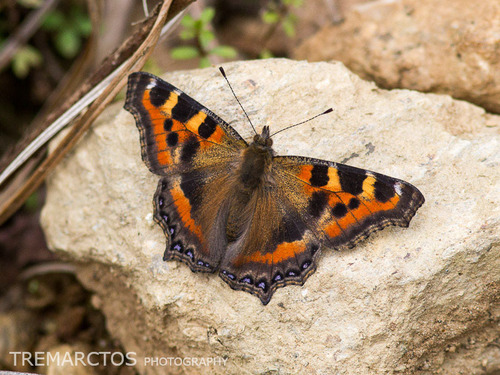
Scientific name: Aglais caschmirensis. For the upperside of the forewings: the basal half of the costa and the termen are pale brown. The basal half of the costa is flecked with pale yellow, while the termen has an inward narrow darker brown border that bears a series of black lunules. Outwardly, the termen is crossed by a sinuous slender subterminal black line and an even more slender terminal black line. The base of the forewing, the greater posterior part of interspace 1a and interspace 1 are brown, dusted with golden scales. The rest of the forewing is yellow on the anterior portion, and red on the posterior portion and at the base of the cell, with the following black markings: a broad band running across the cell, another broader short band beyond it that touches the discocellulars and does not extend below vein 4, and a third that does not extend below vein 5; all three short bands are rounded at the posterior end, and there is a white patch beyond the third, before the apex. On the disc sits a large oval black spot, followed by a yellow patch in interspace 1; above this yellow patch there are smaller black spots in interspaces 2 and 3. For the upperside of the hindwings: the basal half is dusky brown, covered with long brown hairs on the posterior side. Anteriorly, beyond the bases of veins 5, 6 and 7, the area is black, followed by a broad red band that turns yellow toward the anterior. There is also a broad terminal brown band, crossed by a series of black-bordered blue lunules, and beyond these lunules are two very slender, inner and outer, sinuous black lines. The underside of the wings is brown, marked with closely spaced, short transverse black striae. The basal half of the wings is clouded with dark purplish brown. The outer edge of this dark portion is outlined by a highly sinuous jet-black transverse line that is most prominent on the hindwing. Closer to the wing base, the area is also crossed by two or three similar, much interrupted lines. The terminal half of the wings is paler, and bears two dark irregular patches below the costa of the forewing. Finally, a sinuous transverse subterminal narrow dark blue band crosses both the forewings and hindwings, bordered on both sides by slender black lines; this band widens into spots on the veins of the forewing, and is more distinct in females than in males. Antennae are dark brown, with fine white ring markings. Head, thorax, and abdomen are dark brown both above and below. The species has a wingspan of 52 to 63 mm. This species is distributed across the Himalayas from Kashmir to Sikkim, at elevations between 600 and 5,500 metres (2,000 to 18,000 ft). Its subspecies nixa (Grum-Grshimailo, 1890) occurs from the Gissar Range to Darvaz, the Pamirs to the Alay Mountains, and in Afghanistan, Pakistan, and West China.