About Ageratum houstonianum Mill.
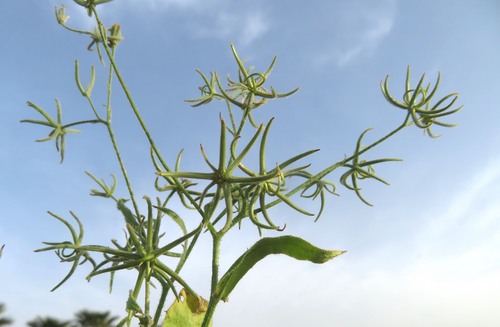
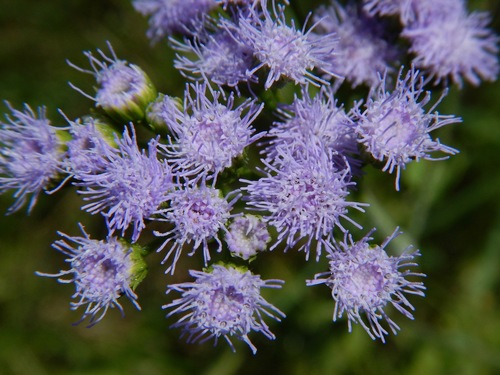
Ageratum houstonianum Mill. is a herbaceous annual plant or dwarf shrub that reaches 0.3–1 m (1 ft 0 in – 3 ft 3 in) in height. It produces ovate to triangular leaves that are 2–7 cm (0.79–2.76 in) long, and blue flowerheads that can occasionally be white, pink, or purple. The flower heads grow in dense corymbs, and the ray flowers have a threadlike shape and fluff-haired texture, which gives the plant its common name. The narrow lanceolate bracts are pointed, only have small teeth along their edges at the top, and are covered in glandular hairs. In the northern hemisphere, this plant flowers from May to November, and it attracts butterflies. This species is native to Central America, specifically Guatemala and Belize, as well as adjacent regions of Mexico. It has become an invasive weed in many other areas, and has also naturalized across large parts of the tropics and the southern United States. It grows in pastures, moist forest clearings, and bushy areas, at altitudes up to 1,000 metres (3,300 ft). Ageratum houstonianum is now widely grown as an ornamental plant, used for summer garden borders and balcony planters, and taller varieties are also grown as cut flowers. It is an annual cultivated crop, with many cultivated varieties that can have dark blue, purple, pink or white flower heads. It prefers cool soils and full sun exposure, and taller cultivated varieties reach up to 60 centimetres (24 in) in height. Ageratum houstonianum contains pyrrolizidine alkaloids, and is toxic to grazing animals, causing liver lesions.