About Agave virginica L.
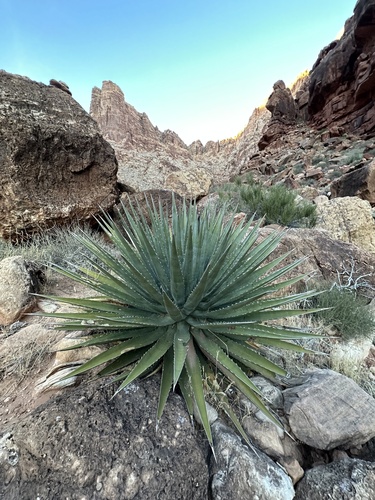
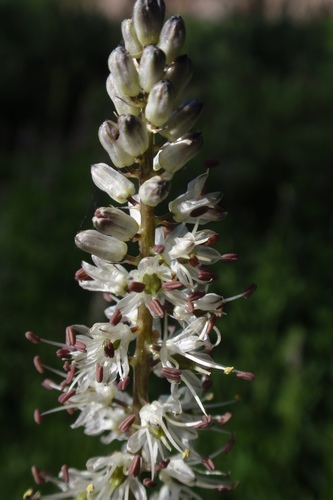
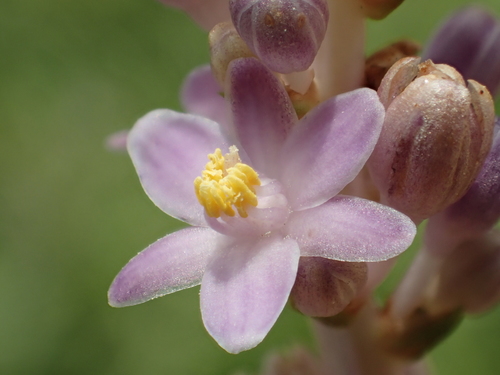
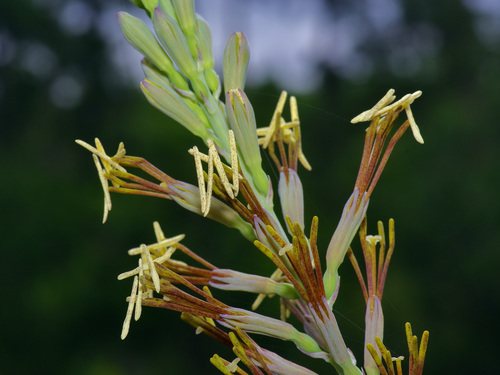
Agave virginica L., commonly called false aloe, is acaulescent, which means it has an extremely short stem. Leaves and flowering stems grow from a bulbous herbaceous caudex. Its fleshy green leaves are usually spotted or speckled with maroon, and measure 10–46 cm (4–18 in) long and 1–6 cm (0.5–2.25 in) across. Leaf margins have fine teeth, and leaves taper to a non-spiny tip. Leaf shape and size in Agave virginica vary based on soil type, amount of shade, length of the cold period, and the position of the leaf in the rosette. Speckles and spots appear frequently on some leaves in most populations, and some authors have used the informal designation "forma tigrina" for these variants. In early summer, leafless flower stalks emerge from the basal leaf rosettes, growing rapidly to reach up to 2.1 m (7 ft) tall. The inflorescence develops from June to August, bearing 10–61 closely spaced flowers arranged in a spike that is roughly 15–61 cm (6–24 in) long. Each flower is 2–3 cm (0.75–1.25 in) long, whitish green or yellowish green, essentially tubular, nearly erect, and slender, with a fragrant sweet fruity scent. Seed capsules are spherical, with a diameter of 1–1.7 cm (0.4–0.7 in). This species is native to a range that extends from North Carolina west to Texas and north to Illinois in the United States, and south to Nuevo León and Tamaulipas in Mexico. It grows in sunny, well-drained habitats including prairies, upland rocky glades, and sandy open woods. It is the only Agave species found north of Texas. Agave virginica is primarily adapted to nocturnal pollination by medium-sized moths and larger sphinx moths. Diurnal pollination by large bees produces significantly less seed set compared to nocturnal pollination and open pollination. Ruby-throated hummingbirds are also attracted to its blooms.