About Agave victoriae-reginae T.Moore
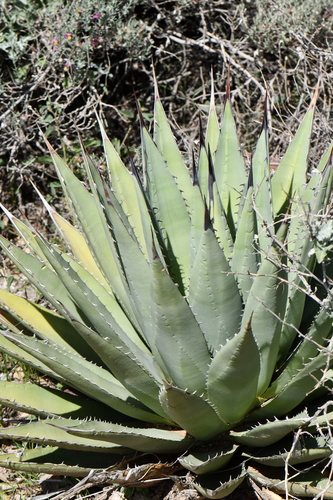
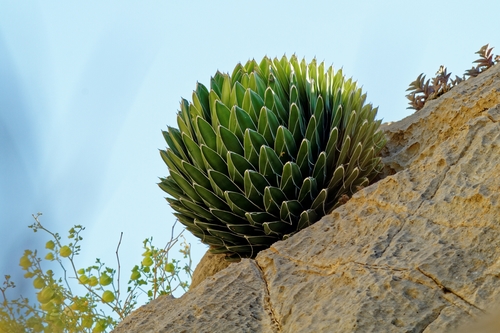
Agave victoriae-reginae, commonly called Queen Victoria agave or royal agave, is a small species of succulent flowering perennial plant. It is known for white streaks on its sculptured, geometric leaves, and is widely popular as an ornamental plant. This agave species varies greatly in form, but its rosettes are generally small and compact, growing up to 0.5 meters across. Rosettes are made up of short, rigid, thick green leaves that bear distinctive patterned white markings. These markings usually appear along the leaf keels or margins, giving the leaf surface a polyhedral appearance. The leaves usually lack marginal teeth, while the tip of the leaf may hold 1 to 3 spines, each between 1.5 and 3 centimeters long. Cream-colored flowers grow on erect racemes that can reach up to 4 meters in length. A. victoriae-reginae is native to the Chihuahuan Desert, where it occurs in the Mexican states of Coahuila, Durango, and Nuevo León. Approximately six subspecies of this species have been named. Its classification is made more complex by the existence of hybrids between this species and a number of other agave species. While the species faces some localized threats, its overall population is stable, and the IUCN does not consider the species as a whole to be threatened. Compared to most other agaves, this species is cold-hardy, which makes it popular as a small landscape accent in many northern gardens. In the United Kingdom, however, it is recommended that this plant be kept in heated conditions under glass during the winter months. It has been awarded the Royal Horticultural Society's Award of Garden Merit. When grown as a houseplant, it grows best when planted in very porous, sandy soil, and provided with either direct sunlight or bright shade. The soil should be allowed to dry out completely between waterings. The plant only needs to be repotted approximately every two to three years. Propagation is typically done by seed, because the plant rarely produces basal shoots.