About Agave tequilana F.A.C.Weber
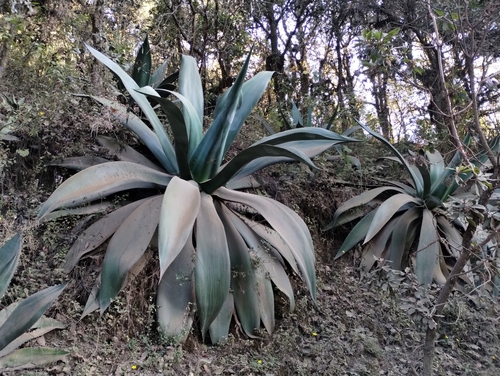
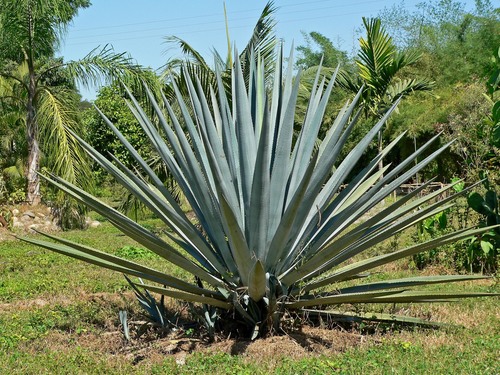
Agave tequilana, commonly known as blue agave or tequila agave, is an agave plant that forms an important economic product of Jalisco, Mexico, because it serves as the base ingredient for tequila. The main characteristic that makes this plant suitable for making alcoholic beverages is its high inulin content in the plant core. Tequila agave is native to the Mexican states of Jalisco, Colima, Nayarit, Michoacán, and Aguascalientes. It grows best at altitudes over 1,500 metres (5,000 ft), and prefers rich, sandy soils. Blue agave grows as a large succulent with spiky, fleshy leaves, and can reach over 2 metres (7 ft) in height. When blue agave plants are around five years old, they sprout a stalk that can grow an extra 5 metres (16 ft), topped with yellow flowers. For commercially cultivated plants, this stalk is cut off to encourage the plant to direct more energy into growing its core. The plant's flowers are pollinated by the greater long-nosed bat, alongside insects and hummingbirds. Each plant produces several thousand seeds, many of which are sterile, and the original plant dies after flowering. Cultivated blue agave is reproduced by planting removed shoots from parent plants, which has caused a significant loss of genetic diversity in cultivated populations. Blue agave is only rarely grown as a houseplant. One notable exception is a 50-year-old blue agave in Boston that grew a 9 m (30 ft) stalk that required a hole cut into the greenhouse roof, and flowered during the summer of 2006.