About Agave salmiana Otto ex Salm-Dyck
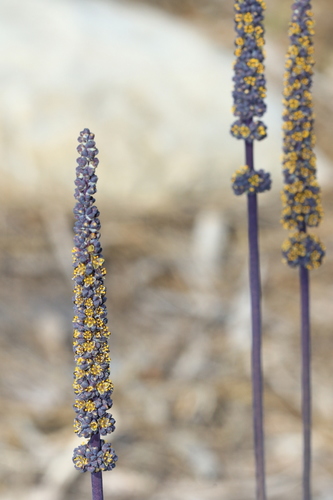
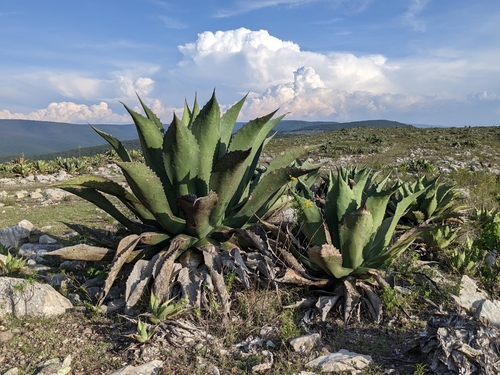
Agave salmiana forms a spiral-shaped rosette with large, flared, erect leaves. These leaves are thick and dark green, with a large sharp point at the tip and strong spines along the edges. When a new leaf unfolds, it leaves an imprint on the leaf beneath it. Like most agaves, this species is monocarpic, meaning it only flowers once before dying. Flowering happens after 15 to 25 years of growth, when the plant produces a vertical floral stem that typically grows up to 4 m (13 ft) long, and bears greenish-yellow flowers. Larger specimens can produce significantly taller floral stems. In 1974, one specimen growing at the Strawberry Canyon Botanical Garden on the University of California, Berkeley campus in Berkeley, California produced an inflorescence with a total height of 16 m (52 ft); the scape (or peduncle) measured about 12 m (39 ft), and the panicle itself measured 4 m (13 ft). Hermann J.H. Jacobsen recorded that an inflorescence of A. salmiana once reached an overall height of 19 m (62 ft), making A. salmiana's inflorescence the tallest of any known plant inflorescence. Mature old plants reach 1.8 m in height, and their leaf rosettes can be 3.6 m in diameter. The variety A. salmiana var. ferox is commonly found in cultivation; the epithet ferox refers to this variety's hard, long spines that can grow up to 8 cm. The species is originally native to southern and central Mexico. It was introduced to Mediterranean climate gardens in Europe, and has sometimes escaped cultivation to become naturalised in the wild in parts of southern Europe. Agave salmiana is easy to cultivate in well-drained sandy soil with full sun exposure. When grown in containers, it needs a very large pot to maintain a balanced, harmonious appearance. It can be used to stabilize slopes. It can tolerate light frost when the soil is completely dry. It is more easily propagated by planting detached shoots than by growing from seed.