About Agave parryi Engelm.
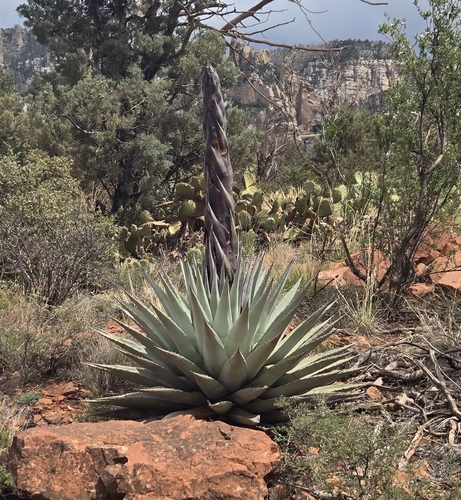
Agave parryi, commonly called Parry's agave or mescal agave, is a flowering succulent perennial plant that belongs to the subfamily Agavoideae of the family Asparagaceae. This slow-growing species is native to Arizona, New Mexico, and northern Mexico. Its leaves are grey-green, each ending in a terminal spine. A key distinguishing trait of this species is that the terminal spine, which is typically dark tan, brown, or black, is darker than the leaf it grows from. Indentations left by older, previous leaves are visible on the back of each new leaf. The Huachuca variety of Agave parryi grows in a rosette form that can reach up to 2 and a half feet in diameter. Thanks to its compact size, low water requirement, and low maintenance needs, the Huachuca agave is a popular landscaping choice for desert residential yards. It needs full sun to grow well. It is generally hardy to approximately −5 °F (−21 °C), though there are documented reports of individual specimens surviving temperatures as low as −20 °F (−29 °C). Parry's agave is an evergreen and monocarpic species: once a mature plant flowers, it produces a 12-foot stalk covered in bright yellow blooms, then dies, because all of the plant's energy is directed to developing the inflorescence, flowering, and pollination. Even though it dies after flowering, A. parryi is one of the most prolific Agave species, and it is easy to propagate. Propagation can be done by removing side shoots with a sterile, sharp knife, or by digging up rhizomatous plantlets that have grown some distance away from the main parent plant. This plant has been awarded the Royal Horticultural Society's Award of Garden Merit.