About Agave ovatifolia G.D.Starr & Villarreal
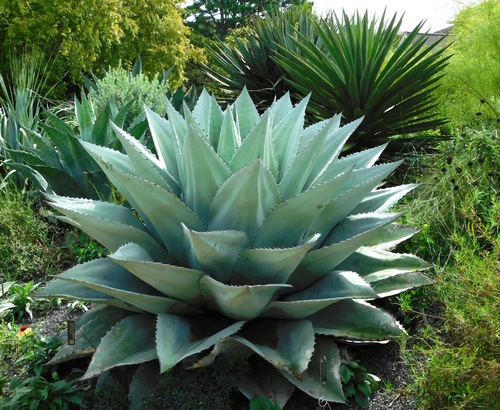
Agave ovatifolia grows solitarily, reaching 60 to 90 cm in growth height and 80 to 120 cm in width. Its bluish to grey, rigid, strong leaves are broadly elliptical to oval, measuring 35 to 40 cm long and 20 to 24 cm wide. Leaf edges are irregularly toothed, and the dark grey to black terminal spine is 2 to 3 cm long. The cracked, straight to slightly curved inflorescence grows 3.5 to 4 m high. Numerous green to yellow flowers, 65 to 75 mm long, form on the middle to upper half of the inflorescence at the ends of loosely arranged, variable branches. The flower tube measures 15 to 20 mm long. Elongated three-chambered capsule fruits are 50 to 60 mm long and 15 to 20 mm wide. Shiny, black, moon-shaped seeds are 5 to 6 mm long and 3 to 4 mm wide.
Agave ovatifolia is endemic to Mexico, growing in the state of Nuevo León, specifically in the Sierra de Lampazos in northern Nuevo León. It grows on stony slopes in limestone soil, in forest and grassland habitats at 1100 to 1300 m altitude. It grows alongside Agave asperrima, Yucca rostrata, Dasylirion species, Ferocactus hamatacanthus, and other cactus and succulent species.
This species was first formally described by Gregory Dirk Starr and José Angel Villarreal-Quintanilla in 2002. It is a member of the group Parryanae. Plants were first collected by Nealley in 1870, and were known informally as "Agave Noah". In 1911, William Trelease invalidly classified this undescribed species as a synonym of Agave wislizenii. Characteristic features of Agave ovatifolia include compact to more open rosettes with bluish to grey, variously arranged, stiff, strong, broadly elliptical to oval leaves, with irregularly toothed leaf margins and a 2 to 3 cm long dark grey to black terminal spine. It is closely related to Agave havardiana and Agave parrasana, the other members of the Parryanae group, but can be distinguished by visible differences in size, and leaf and flower structure. When dry, Agave ovatifolia can survive short periods of frost down to just below 0°F.