About Agave caymanensis Proctor
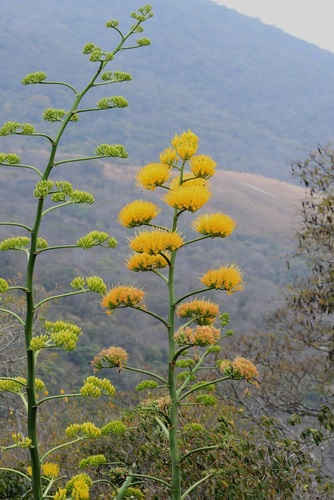
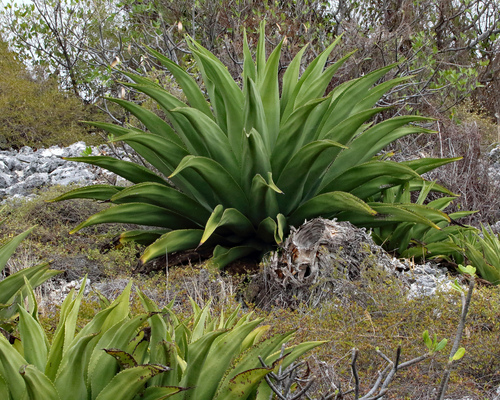
Agave caymanensis is an agave species endemic to Grand Cayman, Little Cayman, and Cayman Brac in the Cayman Islands. It grows in dry shrubland across all elevation levels of these islands. This species gradually develops a short trunk covered in dead leaves. It can reach up to 4 meters in height and 3 meters in width, growing a rosette of large, succulent leaves edged with thorns. It is monocarpic, and its flowering occurs quite synchronously. Young rock iguanas sometimes use the hollow center of this species' dead flower spikes as a shelter. Before being described as a separate species by Proctor in 2012, this species was misidentified as Agave sobolifera. Agave caymanensis has a generation length of 20 to 70 years, and it is a co-dominant species in the xerophytic dry shrublands of the Cayman Islands. Because of its declining population and restricted geographic range, the IUCN has classified Agave caymanensis as an endangered plant. It faces threats from habitat loss and fragmentation caused by all types of development across the islands, including deforestation, urban expansion, tourism development, and land conversion for agriculture. Current estimates indicate there are just over 1 million living Agave caymanensis plants, which marks a major decline from the population of 1.3 to 1.5 million individuals recorded three generations ago. Projections show the species' population will drop by 61% over the next 60 to 100 years. It may also become vulnerable to the invasive agave-feeding weevil Scyphophorus acupunctatus, which affects similar habitats on nearby islands.